
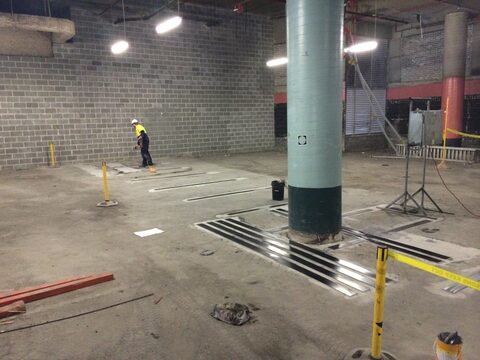
Carbon fiber reinforced polymer (CFRP) systems are widely used to strengthen concrete, steel, and masonry structures. However, the epoxy resins that bind carbon fibers lose significant mechanical strength at temperatures above the glass transition temperature (Tg), typically between 65°C and 120°C (150°F–250°F). In a fire, unprotected CFRP rapidly degrades, compromising the strengthening system. This article reviews fire protection strategies based on internationally recognized guidelines such as ACI 440.2R and fib Bulletin 14, focusing on insulation system design and material selection.
Fire Performance of CFRP Composites
CFRP composites consist of carbon fibers embedded in a polymer matrix, usually epoxy. While carbon fibers themselves can withstand temperatures above 1000°C, the epoxy matrix begins to soften at Tg, leading to a loss of load transfer between fibers. At approximately 300°C (572°F), epoxy ignites and combusts. The fire resistance of a CFRP-strengthened member is defined by the time the system can maintain its load-bearing capacity under standard fire exposure (e.g., ASTM E119 or ISO 834). Without protection, this time is often less than 30 minutes. Design codes generally require fire resistance ratings (FRR) of 1 to 4 hours depending on occupancy.
Fire Protection Design Objectives
The primary design objective is to keep the CFRP-to-substrate bond line temperature below Tg for the required fire duration. A secondary objective is to limit heat transfer to the underlying substrate to prevent loss of concrete cover or steel section capacity. In flexural strengthening, the tension face is often the most vulnerable because CFRP is near the heated surface. For column wrapping, uniform heating must be considered. Design procedures following ACI 440.2R require calculation of the required insulation thickness using transient heat transfer analysis, accounting for fire exposure curve, insulation thermal properties, and substrate thermal inertia.
Common Fire Protection Materials
Several commercially available fire-rated insulation systems can be used over CFRP:
- Vermiculite-based sprays: Lightweight, cementitious mixtures applied by trowel or spray. They provide good adhesion to CFRP and can be built up to required thickness. Thermal conductivity is moderate (k ~0.1–0.2 W/m·K).
- Intumescent coatings: Paint-like materials that expand when heated, forming an insulating char layer. They are thin (1–5 mm dry film) and aesthetically appealing but may require multiple coats and careful surface preparation. Not all intumescents are compatible with epoxy; compatibility testing is essential.
- Mineral wool boards: Rigid or semi-rigid boards (rock or slag wool) with low thermal conductivity (k ~0.04 W/m·K). They are mechanically fastened or adhered over the CFRP. A protective layer (e.g., plaster) is often needed for impact resistance and aesthetics.
- Calcium silicate boards: Dimensionally stable, non-combustible boards with low conductivity. They are attached with mechanical anchors and can be finished with plaster. They offer high durability but may increase dead load.
Selection depends on fire rating, substrate type, environmental exposure (indoor vs. outdoor), and ease of installation over existing CFRP.
Design Considerations for Insulation Systems
Thermal analysis is used to determine insulation thickness. The governing equation for one-dimensional heat conduction can be solved using finite element or analytical methods per standards like EN 1992-1-2 or ACI 216.1. Key parameters include the fire curve (e.g., standard cellulosic or hydrocarbon), substrate thermal properties (concrete, masonry, steel), and the Tg and bond-line temperature limit (often 60°C or 70°C). Anchorage of insulation must account for dynamic effects such as spalling of concrete or thermal expansion of the substrate. In seismic zones, insulation must remain attached during cyclic movement. Vapor barriers may be needed to prevent moisture accumulation behind the insulation, which can affect bond and promote corrosion of steel substrates.
Installation and Quality Assurance
Fire protection systems are applied after CFRP installation and sufficient curing of the epoxy (usually 7–14 days at 23°C). Surface preparation includes cleaning and profiling to ensure adhesion. For spray-applied systems, multiple passes are used to achieve the required thickness with minimal voids. Board systems require mechanical fasteners or adhesive, with joints staggered to minimize heat leakage. Quality assurance includes thickness inspection, pull-off adhesion tests (for cementitious sprays), and thermal imaging to detect gaps. Fire resistance testing of a mock-up assembly (following ASTM E119) is recommended for critical applications.
Special Cases and Code Compliance
In some retrofit scenarios, existing structural members may have insufficient concrete cover or steel fireproofing. The addition of CFRP and its fire protection can compensate for these deficiencies only if the protection extends over the entire heated zone. For columns, full 360° protection is required if the CFRP wrap is continuous. For beams, protection must cover the tension face and extend up the sides a distance determined by shear transfer requirements. Current model codes (IBC/IRC) generally accept engineering designs that follow ACI 440.2R or similar with specific fire-rated assemblies. Always verify local building code amendments.
Conclusion
Effective fire protection of CFRP-strengthened structures is achievable with proper material selection, thermal design, and quality installation. By keeping the CFRP below its glass transition temperature for the required fire duration, the strengthening system retains its capacity, ensuring life safety and structural integrity. Advances in intumescent and cementitious coatings continue to expand design options for engineers seeking thin, lightweight, durable protection.