
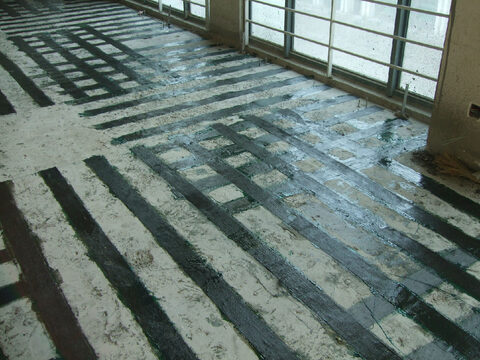
A carbon fiber wrap transfers load only through its bond to the concrete, so the result depends far more on preparation than on the fiber itself. The sequence below follows standard wet-layup practice. It is a general overview, not a substitute for the system’s technical data sheets or the project specification.
1. Prepare the surface
Remove all unsound concrete, laitance, paint, and contaminants. Grind or abrasive-blast the surface to expose the aggregate and reach the specified profile. Round any sharp corners the fabric must wrap to a minimum radius (typically about 13 mm / half an inch) so the fibers are not cut by the edge. Repair spalls and voids, and make sure the surface is clean and dry before moving on.
2. Prime
Apply the epoxy primer by roller or brush and let it penetrate the open pores of the concrete. The primer creates the chemical link between the substrate and the saturating resin. Observe the data-sheet recoat window — bonding too late or too early both weaken the result.
3. Level the surface
Fill bug holes, fins, and offsets with epoxy putty so the fabric beds against a flat, continuous surface. Voids under the fabric become unbonded areas that cannot carry stress.
4. Saturate and lay up the fabric
Cut the fabric to length with the fibers oriented in the design direction. Apply a first coat of impregnating resin to the primed surface, then place the fabric and work resin through it from the centre outward with a ribbed roller until the weave is fully wetted out and air is expelled. Apply a second coat over the top. For multiple plies or wraps, lap the fabric the specified distance in the fiber direction and repeat. Consistent, bubble-free saturation is what gives the laminate its rated strength.
5. Cure, inspect, and protect
Let the system cure undisturbed at the temperatures and times the data sheet requires; keep it from rain and traffic during this period. After cure, tap-test or otherwise sound the laminate for hollow (delaminated) areas and inject or repair any voids found. Where the wrap is exposed to UV, fire, or aggressive environments, apply the specified protective topcoat, render, or fire-rated covering.
Common mistakes to avoid
The failures we see most often trace back to a handful of causes: inadequate surface profile, sharp corners that sever the fibers, mixing resin off-ratio or past its pot life, trapped air from under-rolling, and disturbing the wrap before it has cured. Control those and a wet-layup wrap will perform as designed for decades. Always work within the system’s data and have the installation overseen by a qualified party.