
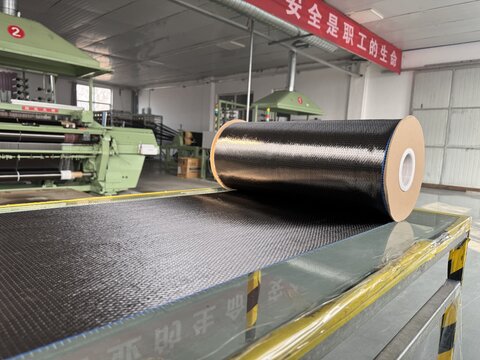
When specifying carbon fiber reinforced polymer (CFRP) systems for structural strengthening, engineers face a critical decision between wet lay-up and prepreg application methods. Both techniques deliver high-strength, lightweight reinforcement, but they differ fundamentally in resin handling, curing requirements, quality control, and field adaptability. Understanding these differences is essential for selecting the method that best aligns with project constraints, performance goals, and site conditions. This article provides a vendor-neutral technical comparison of wet lay-up and prepreg CFRP systems, with reference to industry standards such as ACI 440.2R and fib Bulletin 14.
Fundamental Process Differences
In a wet lay-up system, dry carbon fiber fabric is saturated on-site with a liquid epoxy resin immediately before application. The installer manually impregnates the fabric using rollers or brushes, and the resin cures at ambient temperature or with mild heat. Conversely, prepreg systems use carbon fiber fabric that is pre-impregnated with a partially cured resin (B-stage) under factory conditions. The prepreg is stored at low temperature to retard curing, then applied to the substrate and cured under controlled elevated temperature (typically 120°C–180°C) and pressure, often using vacuum bagging or an autoclave.
Quality Control and Consistency
Prepreg systems offer superior consistency because the fiber-to-resin ratio is precisely controlled during manufacture. The uniform resin content eliminates variability from manual mixing and saturation, leading to predictable mechanical properties and void content below 2–3%. Wet lay-up, however, relies heavily on installer skill; improper saturation can result in dry spots, excess resin, or air entrapment, which reduce laminate strength and durability. For critical applications where traceability and repeatability are paramount, prepreg is often preferred. Industry standards such as ACI 440.2R emphasize that wet lay-up systems require rigorous quality assurance procedures, including coupon testing from each batch installed.
Curing Conditions and Field Constraints
Wet lay-up systems cure at ambient temperature, making them suitable for field applications where heating is impractical or impossible. They can be applied to vertical or overhead surfaces, and the curing progress can be monitored via simple hardness checks. However, ambient curing is sensitive to temperature and humidity; low temperatures slow the reaction, while high humidity can cause surface blushing or incomplete cure. Prepreg systems require elevated temperature curing, typically using heat blankets, ovens, or autoclaves. This demands specialized equipment, electrical supply, and careful temperature ramping to avoid thermal stresses. In many field retrofit projects, providing uniform heating over large areas is challenging and costly, making wet lay-up the more flexible choice despite lower consistency.
Mechanical Performance and Fiber Volume Fraction
Prepregs typically achieve higher fiber volume fractions (55–65%) compared to wet lay-up (30–50%). Higher fiber content translates directly to greater tensile strength and modulus per unit thickness, allowing thinner laminates to achieve the same design load. The controlled cure also minimizes microcracking and residual stresses. Wet lay-up laminates often have lower fiber volume due to excess resin needed for workability and to ensure wet-out. For most building strengthening applications (e.g., flexural or shear strengthening of beams, slabs, columns), both methods can meet design requirements when properly engineered, but prepreg may be specified when space is limited or when maximum stiffness is needed.
Handling, Safety, and Storage
Wet lay-up involves handling liquid resins on site, requiring personal protective equipment (gloves, goggles, respirators for some formulations) and spill containment. Resin mixing ratios must be measured accurately, and pot life limits the working time. Prepreg materials are less messy during lay-up because the resin is already embedded in the fabric, reducing worker exposure to liquid chemicals. However, prepregs require cold storage (typically −18°C or lower) to prevent premature curing, which adds logistics cost and limits shelf life. Wet lay-up materials can be stored at ambient temperature for longer periods, simplifying job site inventory management.
Cost Implications and Project Suitability
Wet lay-up systems generally have lower material cost and require minimal specialized equipment, making them economical for small to medium-sized projects or irregular geometries. Prepreg systems carry higher material and processing costs due to precise manufacturing, cold chain storage, and heat curing. However, in large-scale or high-volume applications (e.g., precast elements, aerospace, or seismic retrofit of multiple identical members), the repeatability and reduced labor for quality control can offset the premium. The choice should be based on a total installed cost analysis considering labor, equipment rental, quality control testing, and the cost of potential rework.
Conclusion
Both wet lay-up and prepreg CFRP systems are proven strengthening technologies. The selection hinges on project-specific factors: required laminate quality and consistency, site curing capabilities, structural geometry, budget, and tolerance for process risk. For critical applications demanding high fiber volume and traceability, prepreg is the standard. For versatile, cost-effective field installation on complex substrates, wet lay-up remains the predominant method. Engineers are encouraged to consult ACI 440.2R and manufacturer guidelines to tailor the approach to their design and construction environment.