
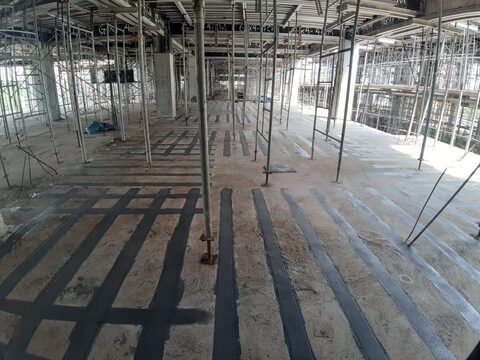
Carbon fiber reinforced polymer (CFRP) systems are widely used for structural strengthening, offering high strength-to-weight ratio and corrosion resistance. However, successful installation requires strict adherence to established procedures. Even minor deviations can compromise bond integrity and long-term performance. This article outlines common CFRP installation mistakes and practical strategies to avoid them, drawing on industry standards such as ACI 440.2R-17.
Inadequate Surface Preparation
The bond between CFRP and substrate depends on proper surface preparation. A common mistake is incomplete removal of laitance, dust, oil, or existing coatings. Contaminants prevent proper epoxy penetration and adhesion, leading to delamination. Concrete substrates must be grit-blasted or mechanically abraded to achieve a clean, open-pore surface with a minimum pull-off strength of 1.5 MPa (per ACI 440.2R). Avoid over-polishing, which can seal pores. Always verify surface cleanliness visually and with a tape pull test before priming.
Improper Mixing and Pot Life Mismanagement
Epoxy resins are two-component systems requiring precise ratio mixing. Errors include using incorrect proportions, incomplete blending, or exceeding the pot life. Under‑catalyzed epoxy will not cure properly; over‑catalyzed may harden too quickly, reducing workability. Always use calibrated scales or metering equipment. Mix thoroughly for the manufacturer’s specified time, scraping sides and bottom. Work in small batches to avoid waste, and discard material that exceeds the pot life. Temperature and humidity affect pot life—adjust batch size accordingly.
Incorrect Primer and Saturant Application
Applying primer or saturant with wrong viscosity or application technique can cause air entrapment or incomplete wet-out. Some installers apply too thick a layer, leading to exothermic heat buildup or uneven saturation. Follow manufacturer’s recommended coverage rates (typically 0.2–0.5 kg/m²). Use a notched trowel or roller to ensure uniform thickness. For wet lay‑up systems, ensure the dry fiber is fully impregnated—no white or dry spots. Vacuum bagging may be required for thick laminates to remove voids.
Poor Fiber Alignment and Positioning
CFRP is strongest along its fiber direction. Misalignment of even a few degrees can reduce strength significantly. Use chalk lines or laser guides to mark fiber orientation. For plate bonding, ensure the plate is straight and centered. Avoid wrinkles or bridging over irregularities—these create stress concentrations. If multiple layers are applied, stagger splices and maintain fiber continuity. Check alignment after application and before cure.
Inadequate Curing Conditions
Epoxy cure is temperature- and moisture-dependent. Applying CFRP when ambient or substrate temperature is below the minimum (often 10°C or 50°F) slows cure and may cause incomplete cross-linking. High humidity can cause blush (surface amine reaction), reducing bond strength. Monitor and record temperature and relative humidity during application and for the required cure period. Use enclosures, heaters, or dehumidifiers if necessary. Do not load the structure until full cure is verified (e.g., by barcol hardness or touch).
Neglecting Anchoring and Edge Details
Premature debonding often starts at unanchored ends or edges. Inadequate termination zones or lack of mechanical anchors can lead to plate end peeling. ACI 440.2R recommends U‑wrap or spike anchors at terminations. For flexural strengthening, extend CFRP past the theoretical termination point and provide sufficient end anchorage. Ensure radius corners (≥13 mm) to avoid stress concentrations. Inspect anchors for proper embedment torque.
By addressing these common mistakes through careful planning, training, and quality control, installers can achieve reliable and durable CFRP strengthening. Always follow manufacturer instructions and relevant standards; document each step for traceability.