
Carbon fiber plate and carbon fiber fabric are both CFRP, yet they are installed differently and suit different jobs. Picking the wrong one wastes material and labour; picking the right one makes the strengthening efficient and durable.
Carbon fiber plate (pre-cured laminate)
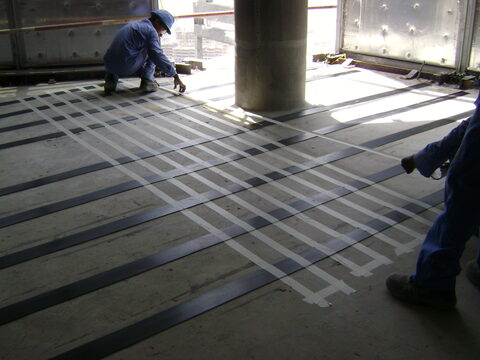
Plate, or laminate strip, is manufactured under factory control by pultrusion, so the fiber volume and alignment are consistent and the strip is already cured and rigid. On site it is bonded to a flat surface with a thixotropic plate adhesive. Because the fibers run in one direction and the cross-section is dense, plate is the most efficient option for flexural strengthening — adding bending capacity to the soffit of beams and slabs. Installation is fast and clean: cut to length, apply adhesive, press into place. The trade-off is that plate is straight and stiff, so it only suits flat or near-flat surfaces.
Carbon fiber fabric (wet layup)
Fabric is a dry woven or unidirectional sheet that is saturated with impregnating resin on site and pressed onto the member. Being flexible before cure, it wraps around corners, columns, and curved or irregular shapes that plate cannot follow. This makes fabric the natural choice for shear strengthening (U-wraps around beams) and column confinement (full wrapping to improve ductility and axial capacity), as well as for masonry and complex geometry. The trade-offs are that on-site saturation demands more care for quality control, and final fiber content is less consistent than a factory plate.
Side by side
In short: plate is rigid, factory-cured, one-directional, and ideal for flexural strengthening of flat surfaces with fast installation. Fabric is flexible, saturated on site, can be oriented in multiple directions, and excels at shear, confinement, and curved or irregular geometry. Plate offers the most consistent quality; fabric offers the most versatility.
How to choose
Start with geometry: if the surface is flat and you are adding bending capacity, plate is usually the most cost-effective answer. If you need to wrap a corner, confine a column, or strengthen in shear, fabric is the right tool. Many real projects use both — plate on the soffit for flexure and fabric U-wraps at the ends for shear. The load direction matters too: align the fibers with the principal tensile stress, and remember fabric can be layered in several directions where plate cannot.
Whichever form you choose, the compatible primer, resin, or adhesive from the same system is part of the design — mixing components from different systems voids the tested performance. When in doubt, let the structural demand and the member shape decide, and confirm with your engineer.