
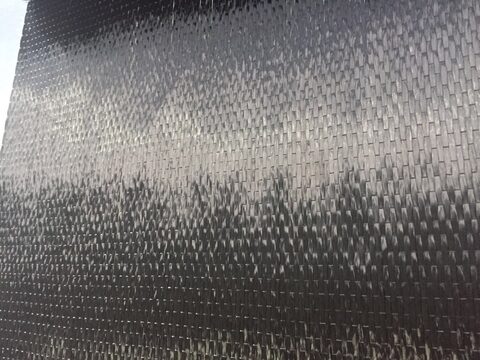
CFRP — Carbon Fiber Reinforced Polymer — is a composite of high-strength carbon fibers held in a cured epoxy matrix. Bonded to the surface of an existing structural member, it adds tensile capacity exactly where the member needs it, turning an under-strength beam, slab, column, or wall into one that meets today’s loads. It does this without the demolition, downtime, and added dead weight that traditional methods bring.
Why carbon fiber?
The appeal comes down to the material itself. Carbon fiber has a tensile strength several times that of structural steel at roughly a fifth of the weight, and it does not corrode. A laminate only about a millimetre thick can replace a steel plate many times heavier. Because the reinforcement is thin and light, it can be installed by hand, overhead, and in tight spaces where bolting steel plates would be impractical.
How it works
Strengthening relies on the bond between the composite and the substrate. The fiber carries tension; the epoxy adhesive transfers stress from the concrete into the fiber across the bonded area. The host structure must therefore be sound: loose material, laitance, and contamination are removed, the surface is ground to expose aggregate, and a primer is applied so the saturating resin can grip. When the system cures, the member and the CFRP act compositely as one.
Where it is used
Typical applications include: increasing the live-load rating of bridge girders and parking decks; restoring capacity lost to corrosion or impact; adding flexural or shear strength after a change of use; confining columns to improve ductility and axial capacity; and seismic upgrades. CFRP works on reinforced concrete, prestressed concrete, steel, masonry, and timber.
Two common forms
The system comes mainly as flexible fabric (also called sheet or wrap), which is saturated with resin on site and conforms to curved and irregular shapes, and as rigid pre-cured plate (laminate strip), which is bonded to flat soffits for efficient flexural strengthening. Choosing between them is the subject of its own guide.
Advantages and limits
The advantages are speed, minimal added weight, corrosion resistance, and almost no change to member dimensions or clearances. The limits matter too: CFRP is a surface-bonded tension reinforcement, so the existing member must have enough compression capacity to begin with; performance depends heavily on surface preparation and on installer skill; and bare carbon fiber loses strength in fire, so fire-rated assemblies need protective coatings or boards. Design should always follow a recognized code such as ACI 440.2R and be carried out by a qualified engineer.
Used within those limits, CFRP strengthening is one of the fastest, least disruptive ways to extend the service life of an existing structure.