
At a glance
- ACI 440.2R names open parking structures as “exterior” exposure — carbon’s environmental factor CE = 0.85, the same class as bridges (Table 9.4). Even the harshest “aggressive” row keeps carbon at 0.85; only glass drops (to 0.50).
- Repeated wheel loads are handled by a service-stress cap, not a separate fatigue equation: carbon is limited to 0.55 ffu under sustained-plus-cyclic load (Table 10.2.9) and is the least fatigue-sensitive FRP fiber.
- Realistic flexural gain is ~40% (not the 10–160% lab range), and CFRP does not fix punching shear at columns — a scope limit worth knowing before you specify.
CFRP is well suited to parking-deck slabs — it is thin, non-corroding on a salted deck, and adds negligible dead load — but design is governed by exposure factors, a fatigue-driven service-stress cap, and the same debonding limits as any bonded system, and it strengthens bending, not punching shear. This guide covers the parking-specific decisions, grounded in ACI 440.2R and ACI SPEC-440.12-22. New to bonded FRP? Start with what CFRP strengthening is.
Why do parking-deck slabs lose capacity?
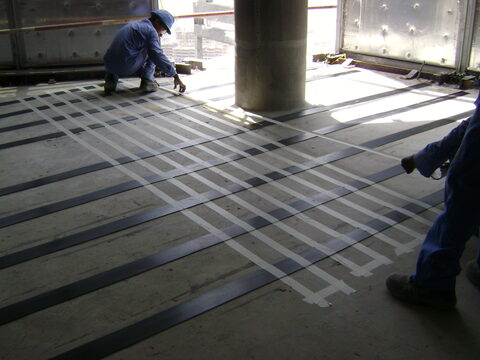
Two forces, usually together. Deterioration: de-icing salt and coastal chlorides penetrate the deck, corrode the reinforcement, and spall the concrete — the classic reason a deck needs its capacity restored. Load change: heavier vehicles or a re-rating push demand past the original design. CFRP answers both: it is non-metallic and does not corrode on a salted deck (unlike a bonded steel plate), and at roughly one-fifth the density of steel it adds negligible dead load to a structure already carrying vehicles. FidStrong’s FSC fabric data sheet lists “parking lots and industrial floors” and “corrosion protection” directly among its uses.
Indoor, outdoor, or harsh — which exposure applies?
ACI 440.2R Table 9.4 settles it: open parking structures are listed under “exterior” exposure, the same row as bridges and piers, giving carbon CE = 0.85. This environmental factor multiplies the fiber’s characteristic strength and strain before any other reduction. A useful feature of carbon: even if an engineer judged a heavily de-iced deck “aggressive,” carbon’s factor still holds at 0.85 — the classification only matters for glass fiber, which falls to 0.50.
| Fiber | Interior | Exterior (open parking) | Aggressive |
|---|---|---|---|
| Carbon | 0.95 | 0.85 | 0.85 |
| Glass | 0.75 | 0.65 | 0.50 |
(ACI 440.2R does not define a separate “de-icing salt” class, so whether a specific deck is exterior or aggressive is an engineer’s judgment — but for carbon the number is 0.85 either way.)
Will repeated wheel loads fatigue the CFRP?
The design already accounts for cyclic traffic — not through a fatigue curve, but through a service-stress cap. Under sustained-plus-cyclic load, carbon FRP stress is limited to 0.55 ffu (ACI 440.2R Table 10.2.9), far below the strain used in a one-time ultimate check, and against 0.20–0.30 for glass and aramid. Carbon is separately identified as the least fatigue-sensitive FRP fiber, with the best creep-rupture endurance (about 0.90 of strength retained at 50 years, versus 0.30 for glass). Keep the service-level CFRP stress under 0.55 ffu and repeated vehicle loading is covered.
How much capacity can CFRP add, and where does it go?
Be realistic: lab tests report 10–160% flexural gains, but after the debonding-strain limit and the 0.85 FRP strength-reduction factor, the practically achievable range is about 40%. On a continuous deck the CFRP goes on the soffit at midspan (sagging moment) and on the top surface over supports (hogging moment) — and the top-face laminate sits under the wheel-traffic wearing surface, so it needs a protective overlay. Debonding governs the usable strain everywhere: εfd = 0.41√(f′c/(n·Ef·tf)) ≤ 0.9εfu (Eq. 10.1.1), and a 375-beam database of unanchored bonded beams failed 70% by intermediate-crack debonding, 30% by end debonding — none by fiber rupture.
What must be true before bonding — and how is it verified?
The prerequisites are non-negotiable. Concrete pull-off (tensile) strength must be ≥1.4 MPa (200 psi) with failure inside the concrete (ASTM C1583; ACI 440.2R Sec. 1.2.1.4); FidStrong’s data sheets set ≥1.5 MPa. Cracks wider than 0.3 mm must be epoxy-injected first (Sec. 6.4.1) — FidStrong’s FSE523 injection epoxy reaches 1.8 MPa bond even on wet concrete. After installation, ACI SPEC-440.12-22 requires field pull-off testing (ASTM D7522): pass only if strength exceeds 200 psi and failure is in the substrate, at 3 tests per 1,000 ft² and a minimum of 3 per day, with delaminations over 2 in² repaired.
What won’t CFRP fix on a parking deck?
The important limit: CFRP does not solve punching shear at flat-slab columns. ACI 440.2R covers flexure, one-way shear, confinement, and seismic — there is no two-way (punching) shear design method in the externally bonded guide. If the deficiency is punching around a column head, CFRP EBR is not the documented fix; the answer is shear studs, capitals, or drop panels. Diagnose the governing failure mode first — adding soffit CFRP to a punching-critical slab does not address it. For the closely related floor case, see increasing warehouse floor capacity.
FAQ
Is a parking deck treated as outdoor or harsh exposure for CFRP design?
ACI 440.2R Table 9.4 lists open parking structures under “exterior” exposure, giving carbon CE = 0.85 — the same class as bridges and piers. There is no separate de-icing category, and even the “aggressive” row keeps carbon at 0.85, so the classification matters far less for carbon than for glass fiber.
Will repeated wheel loads fatigue the CFRP over time?
The check is a sustained-plus-cyclic service-stress cap of 0.55 ffu for carbon (ACI 440.2R Table 10.2.9), not a separate fatigue equation, and carbon is the least fatigue-sensitive FRP fiber. Keep service-level stress under that cap and cyclic vehicle loading is accounted for.
How much extra load can CFRP add to a parking slab?
Realistically about 40% in flexure. Lab tests show 10–160% gains, but after the debonding-strain limit and the 0.85 FRP strength-reduction factor, ~40% is the practical range. Don’t design to lab-maximum numbers.
Do cracks and surface condition need fixing before CFRP goes on?
Yes. Any crack wider than 0.3 mm must be epoxy-injected first (Sec. 6.4.1), and substrate pull-off strength must clear 1.4 MPa (ACI) / 1.5 MPa (FidStrong) before bonding. After cure, field pull-off tests must exceed 200 psi with failure in the substrate.
Can CFRP fix punching shear at the columns?
No. ACI 440.2R has no punching (two-way) shear design method; it covers flexure, one-way shear, confinement, and seismic. Punching deficiencies need shear studs, capitals, or drop panels — not bonded CFRP.
Why CFRP instead of a bonded steel plate on a salted deck?
Because CFRP does not corrode — a decisive advantage on a chloride-laden deck — and at roughly one-fifth of steel’s density it adds negligible dead load. One caution: carbon is electrically conductive, so keep the laminate from directly contacting exposed steel to avoid a galvanic couple.
FidStrong manufactures FSL CFRP plate and FSC carbon fabric with matched saturating epoxies and plate adhesives for deck strengthening, under ISO 9001, 14001, and 45001 systems. Design values here follow ACI 440.2R and ACI SPEC-440.12-22; CFRP raises flexural capacity, not punching shear. Confirm the governing failure mode and every value against the code and a qualified engineer’s design.