
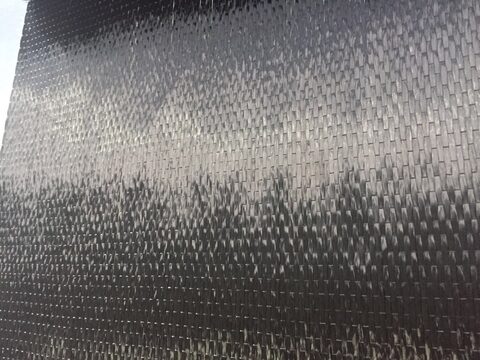
At a glance
- CFRP: carbon fiber reinforced polymer — high-strength (PAN-based) carbon fiber locked in a cured epoxy matrix; density 1.5–1.6 g/cm³, about one-fifth of steel (ACI 440.2R Table 4.2.1).
- What it is: CFRP strengthening bonds high-strength carbon fiber (≈4,500 MPa, 240 GPa per ASTM D3039) to a concrete, masonry, or steel member with a structural epoxy, so the fiber carries tension the original section cannot.
- How it works: the epoxy makes the fiber strain with the structure; design caps the usable strain well below rupture to prevent debonding — the dominant failure mode — per ACI 440.2R.
- Where it wins: at roughly 1/5 the density of steel it adds almost no dead load or seismic mass, installs without downtime, and strengthens in flexure, shear, or confinement.
CFRP strengthening is the practice of bonding thin, high-strength carbon fiber to an existing structure so it can carry more load than it was built for — without the weight, welding, or downtime of steel plates or a bigger concrete section. This guide explains what CFRP is, how a few millimetres of fiber can strengthen a concrete beam, the three ways it is applied, and where it does and does not make sense. Every figure is traced to ACI 440.2R or to FidStrong’s tested product data.
What is CFRP, and what does it do?
CFRP — carbon fiber reinforced polymer — is high-strength carbon fiber embedded in a polymer matrix, almost always epoxy. The fiber carries tension; the matrix transfers shear between filaments and protects them. On its own the fiber is just a bundle of filaments, so the resin is what turns it into a structural material. (When the matrix is an inorganic cement mortar instead of epoxy, the system is FRCM, not FRP.)
In finished form, FidStrong high-strength carbon fabric reaches about 4,500 MPa mean tensile strength at 240 GPa modulus (ASTM D3039, net-fiber basis), while a pultruded plate laminate is rated on its whole cross-section — for example 2,900 MPa at 165 GPa. Those are enormous numbers next to concrete, which is why a layer under a millimetre thick can matter.
CFRP key properties at a glance. The five CFRP material values engineers ask about most, each traced to ACI 440.2R or to FidStrong test data:
| Property | CFRP | Comparison / source |
|---|---|---|
| Density | 1.5–1.6 g/cm³ | Steel 7.9 g/cm³ — ACI 440.2R Table 4.2.1 |
| Longitudinal thermal expansion (CTE) | −1 to 0 ×10−6/°C | Concrete 7–11 ×10−6/°C — ACI 440.2R Table 4.2.2 |
| Tensile strength / modulus | 4,500 MPa / 240 GPa | FidStrong FSC fabric, ASTM D3039, net-fiber basis |
| Epoxy glass-transition temperature (Tg) | 60–82 °C | Service temperature ≤ Tg − 15 °C — ACI 440.2R §1.2.1.3 |
| 50-year creep-rupture stress ratio | ≈ 0.90 | Glass FRP ≈ 0.30 — ACI 440.2R §4.4.1 |
How does CFRP strengthening work? The bond mechanism
The epoxy bonds the fiber to the member so the two deform together — strain compatibility — and the fiber picks up tensile force the cracked concrete cannot. Critically, the design never lets the fiber reach its breaking strain. It is capped by a debonding-strain limit: for externally bonded flexural reinforcement, ACI 440.2R sets εfd = 0.41√(f′c / (n·Ef·tf)) ≤ 0.9εfu.
That is why CFRP designs look conservative next to the raw fiber strength: “4,500 MPa fiber” is not “4,500 MPa usable in this joint.” The layer peels off the substrate before the fiber ever fails, so the whole design revolves around keeping the bond intact. Two techniques exist: externally bonded reinforcement (EBR), the fabric or plate glued to the surface, and near-surface-mounted (NSM) strips set into grooves cut in the cover, which earns a higher debonding allowance (εfd = 0.7εfu).
What are the three ways CFRP strengthens a structure?
CFRP works in three modes, distinguished by where the fiber points. Get the orientation wrong and the strengthening does nothing.
- Flexural: a strip bonded along the tension face raises bending capacity, with an FRP-contribution factor ψf = 0.85 (ACI 440.2R §10.2.10).
- Shear: strips bonded across the web as a U-wrap or full wrap add shear capacity — a full wrap is most efficient (ψf = 0.95) versus a three-sided U-wrap (ψf = 0.85), per ACI 440.2R Table 11.3.
- Confinement: a circumferential wrap around a column restrains the concrete’s lateral expansion under load, raising both its confined strength and its ductility — a core seismic-retrofit technique (see how to size the number of wraps).
Fabric or plate — which CFRP system?
Both use the same carbon fiber; they differ in how they are made and applied. Fabric is a dry weave saturated with epoxy on site, so it conforms to corners and curves — the default for shear U-wraps and column confinement. Plate is a factory-pultruded, pre-cured laminate (about 65% fiber content, 1.6 g/cm³) bonded flat, delivering high force per unit width with fewer layers — ideal for straight beam and slab soffits. Our dedicated guide on carbon fiber plate vs. fabric works through the decision in full.
| Property | CFRP fabric (FSC, wet lay-up) | CFRP plate (FSL, pultruded) |
|---|---|---|
| Tensile strength | 4,500 MPa (net fiber) | 2,900 MPa (laminate) |
| Modulus | 240 GPa | 165 GPa |
| Thickness | 0.11–0.33 mm per ply (200–600 g/m²) | 1.2–3.0 mm precured |
| Best for | Wraps, corners, curved & congested surfaces | Flat soffits, high one-way force, fast QC |
Fabric values: FidStrong FSC data (ASTM D3039). Plate values: FidStrong FSL data. Confirm project values against the product data sheet.
Why choose CFRP over steel plates or a bigger section?
CFRP solves a specific problem exceptionally well: adding capacity with almost no weight or disruption. At 1.5–1.6 g/cm³ it is roughly a fifth the density of steel (7.9 g/cm³) (ACI 440.2R Table 4.2.1), so the strengthening layer adds negligible dead load, does not reduce headroom, and adds no seismic mass — mass being extra inertial force in an earthquake. It bonds rather than bolts or welds, so work proceeds with the structure in service.
Carbon is also the most durable FRP for sustained load: its 50-year creep-rupture stress ratio is about 0.90 versus 0.30 for glass (ACI 440.2R §4.4.1), and its outdoor environmental reduction factor is 0.85 versus 0.65 for glass (Table 9.4). It is not a blanket “stronger” option, though — its usable strain is deliberately capped, and ACI 440.2R explicitly excludes it from compression-zone reinforcement and from concrete weaker than f′c = 17 MPa.
What are the limits of CFRP strengthening?
Three limits govern every design. First, debonding: the Oller database of 375 unanchored FRP-strengthened beams cited in Eurocode 2 Annex J (§7.1) failed 100% by debonding (70% intermediate-crack, 30% end), which is why end anchorage and a sound substrate — pull-off tensile strength ≥ 1.4 MPa (200 psi, ACI 440.2R §1.2.1.4, tested to ASTM C1583); FidStrong data sheets specify ≥ 1.5 MPa — are mandatory. Second, temperature: epoxy softens near its glass-transition temperature (Tg typically 60–82 °C), so service temperature must stay below Tg − 15 °C, and an unprotected system loses its strengthening effect in a fire. Third, UV: cured epoxy CFRP must never be left exposed outdoors without a protective topcoat.
FAQ
What exactly is CFRP, in plain terms?
CFRP (carbon fiber reinforced polymer) is high-strength carbon fiber combined with a polymer matrix, usually epoxy. The fiber alone cannot carry load — it needs the resin to transfer shear between filaments and protect them. FidStrong’s carbon fiber is PAN-based, and the finished composite reaches roughly 4,500 MPa tensile strength at 240 GPa modulus.
How does bonding a thin sheet of carbon fiber make a concrete beam stronger?
The epoxy bonds the fiber to the tension face so it strains together with the concrete and picks up tensile force the concrete cannot. The usable (“effective”) strain is capped well below the fiber’s breaking strain by a debonding-strain formula, not by fiber failure — which is why designs look conservative relative to raw fiber strength (ACI 440.2R eq. 10.1.1).
Should I use carbon fiber fabric or plate?
Fabric is wet-laid on site, so it wraps corners and curved surfaces — the default for shear U-wraps and column confinement. Plate is a factory-pultruded laminate (1.6 g/cm³, ~65% fiber) bonded flat, delivering higher force per unit width with fewer layers, so it suits straight beam and slab soffits needing high flexural capacity.
Is CFRP as strong as bolting on a steel plate?
It solves a different problem well: CFRP density is about a fifth of steel’s (1.5–1.6 vs. 7.9 g/cm³), so it adds almost no self-weight or seismic mass and needs no downtime. It is not a blanket “stronger” — its usable strain is limited by debonding checks, and ACI 440.2R excludes it from compression-zone use and concrete below f′c = 17 MPa.
What is the most common way a CFRP job fails?
Debonding — the FRP peeling away before it reaches its tensile capacity. The Oller database of 375 unanchored FRP-strengthened beams, cited in Eurocode 2 Annex J §7.1, found debonding in 100% of them (70% intermediate-crack, 30% end), which is why end anchorage and a clean, tested substrate (pull-off ≥ 1.4 MPa per ACI 440.2R §1.2.1.4; FidStrong data sheets specify ≥ 1.5 MPa) are non-negotiable.
Can CFRP be used outdoors or where fire resistance matters?
Outdoors yes, but cured epoxy CFRP must never be left UV-exposed — a protective topcoat is mandatory. In fire, an unprotected epoxy system loses its strengthening effect once temperature exceeds Tg − 15 °C (Tg is typically 60–82 °C), so fire-rated cases need a protective coating or an inorganic FRCM alternative.
Which design codes govern CFRP strengthening?
Externally bonded CFRP is designed to ACI 440.2R in the United States and most export markets, to fib Bulletin 14 and the new Eurocode 2 Annex J in Europe, and to CNR-DT 200 R1/2013 in Italy; cement-matrix FRCM systems fall under ACI 549.4R instead. All share the same logic — cap the usable fiber strain to prevent debonding — but differ in partial factors, so confirm which document your local authority has adopted before sizing a layout.
To go deeper, see how the American and European codes diverge in our comparison of ACI 440 vs. fib Bulletin 14, how to interpret the mean-versus-characteristic values on a spec sheet in how to read a CFRP data sheet, and the role of the resins in our structural epoxy adhesives guide.
FidStrong manufactures FSC carbon fiber fabric and FSL carbon fiber plate, tested to ASTM D3039, under ISO 9001, 14001, and 45001 quality systems, and supplies the matching primer, saturating epoxy, and plate adhesives. Design values here are drawn from ACI 440.2R; confirm project-specific values against the governing code and the product data sheet.