
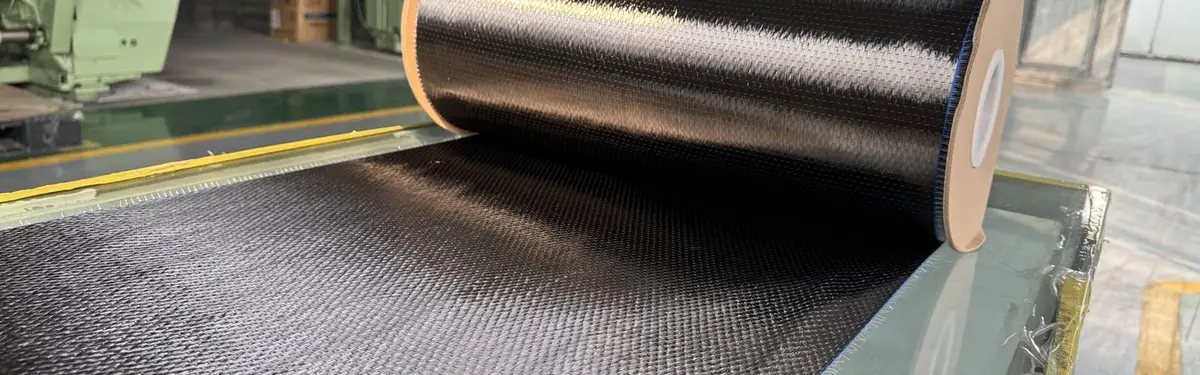
Carbon Fiber Epoxy Resin for Fabric Impregnation
Two-component epoxy resin for saturating carbon fiber fabric in lay-up applications.

Specifications at a glance
The saturating resin is what turns a dry carbon fabric into a laminate. It wets out every filament, transfers stress between the fibres and bonds the whole thing to the concrete — which is why the fabric’s catalogue strength means very little until the resin has done its job properly on site. FSE 322 is the standard grade at 55 MPa tensile and 3.1 GPa, with two siblings for the two jobs it does not suit: FSE 323H for overhead and vertical work, FSE 323L for heavy-weight fabric.
| Property | Value |
|---|---|
| Appearance (Mixed) | Light yellow |
| Mix Ratio | A:B = 2:1 by weight |
| Packaging | 20 kg (A) + 10 kg (B) per kit |
| Pot Life (23°C) | 70 min |
| Touch-Dry Time | 1.5 h |
| Full Cure | 7 days |
| Service Temperature | −5°C to +40°C |
| Thixotropic Index | ≥ 3.0 |
| Non-volatile Content | ≥ 99.5% |
| Tensile Strength (ASTM D638) | 55 MPa |
| Tensile Elastic Modulus | 3.1 GPa |
| Elongation | 2.3% |
| Flexural Strength | 80 MPa |
| Compressive Strength | 90 MPa |
| Steel-to-Steel Tensile | ≥ 40 MPa |
| Steel-to-Steel Shear (ASTM D1002) | ≥ 14 MPa |
| Bond to Concrete (ASTM C882) | ≥ 2.5 MPa (concrete failure) |
| Consumption (200 g/m² fabric) | 0.5–0.7 kg/m² per layer |
Where It Is Used
Beam and slab flexural strengthening
The everyday wet lay-up: fabric bonded to a soffit to raise flexural capacity where load has increased or reinforcement has corroded.
Column wrapping and confinement
Where the fabric has to follow a round or rectangular section — the case a pre-cured plate cannot do. Wrapping is why the thixotropic grade exists.
Shear strengthening with U-wraps
Sides and soffit in one pass, on beams where the shear demand has risen or the stirrups have corroded.
Overhead work
Soffits and ceilings, where a standard saturant runs off and a high-thixotropy grade stays where you put it.
Heavy-weight fabric
600 g/m² and above, where the resin has to travel through a thick tow before it gels — the case FSE 323L is formulated for.
Masonry and timber
Walls, vaults and beams in older structures, where a wrap follows geometry that no rigid product will.
Selection Guide
| Model | What it is for | Choose it when |
|---|---|---|
| FSE 322 | Standard fibre-saturating resin · 2 : 1 by weight | The default for horizontal and gently sloping surfaces with fabric up to about 300 g/m². The longest pot life of the three at 70 min, which is what you want when you are laying up area rather than fighting gravity. |
| FSE 323H | High-thixotropy · 3 : 1 by weight | Overhead and vertical work. It holds on the surface instead of running, and the higher modulus (4.0 GPa against 3.1) stiffens the laminate slightly. Pot life drops to 60 min — mix smaller batches. |
| FSE 323L | Low viscosity, < 500 mPa·s · 3 : 1 by weight | Heavy-weight fabric, where a thicker resin cannot get through the tow before it starts to gel. Highest tensile of the three at 60 MPa, shortest pot life at 50 min. Not for overhead work — it is deliberately runny. |
| The system | Product | Why it is there |
|---|---|---|
| 1. Primer | FSE 302 — moisture-tolerant, 0.3–0.5 kg/m² per coat | Seals the prepared concrete so the saturant is not drawn into the pores and starved. Over-coat within 2–24 h at 23 °C — miss that window and the surface has to be abraded again. |
| 2. Levelling (if needed) | FSE 502 — trowel-grade repair paste | Fills blowholes, honeycombing and chipped areas. Fabric bridging a void has no bond there, and that is where debonding starts. |
| 3. Saturant | FSE 322 / 323H / 323L | Wets out the fabric and bonds the laminate. This is the layer whose quality is decided on site rather than in the factory. |
| 4. Fabric | FSC carbon fabric | The fibre that carries the load once the resin has transferred stress into it. |
All three saturants share the same working envelope: touch-dry in 1.5 h, full cure at 7 days, service range −5 °C to +40 °C, non-volatile content ≥ 99.5%. What differs is rheology and pot life — which is to say, what the resin does while you are working with it, not what it becomes afterwards.
Pot life is quoted for a 500 g mass at 23 °C, and both numbers matter. A bigger batch generates its own heat and goes off faster than the datasheet says, and so does a hot day. On a 35 °C site with a 5 kg mix you will not get 70 minutes. Mix what two people can lay up before it starts to thicken, and no more.
The Three Saturants Compared
Working properties and cured properties
| Model | Mix ratio | Pot life at 23°C (min) | Tensile (MPa) | Modulus (GPa) | Thixotropic index |
|---|---|---|---|---|---|
| FSE 322 | 2 : 1 | 70 | 55 | 3.1 | ≥ 3.0 |
| FSE 323H | 3 : 1 | 60 | 53 | 4.0 | ≥ 3.0 |
| FSE 323L | 3 : 1 | 50 | 60 | 3.1 | — |
Mix ratio is by weight, not by volume — getting that wrong is the most common way to end up with resin that never reaches strength. Tensile and modulus to ASTM D638; all three reach 80–81 MPa flexural (ASTM D790) and 90 MPa compressive (ASTM D695), and all three bond to concrete at ≥ 2.5 MPa with failure in the concrete rather than the bond line (ASTM C882). FSE 323L has no thixotropic index because it is a deliberately low-viscosity formulation, < 500 mPa·s at 25 °C.
Notice how little the cured numbers differ — 53 to 60 MPa across the range — and how much the working numbers do. You are choosing a saturant for how it behaves during the twenty minutes you are laying up, not for its datasheet strength. The laminate’s structural properties come from the carbon, and the resin’s job is to get the load into it.
Wet Lay-Up in Six Steps
Prepare and test the substrate
Grind back laitance and unsound material to expose sound aggregate, then round off sharp corners — a fabric turning a sharp arris tears there. Confirm the surface tensile strength by pull-off test against the project specification; a visual check does not tell you.
Prime, and watch the window
Apply FSE 302 at 0.3–0.5 kg/m². It tolerates a damp substrate but not standing water. The over-coating window is 2–24 h at 23 °C: too early and the primer is still soft, too late and it has to be abraded and re-primed.
Level what the fabric cannot bridge
Fill blowholes, chipped edges and honeycombing with FSE 502 and let it cure. Every void left under the fabric is an area with no bond and a starting point for debonding.
Mix by weight, in batches you can use
Weigh A and B — 2 : 1 for FSE 322, 3 : 1 for the 323 grades. Mix mechanically at low speed for the full time on the TDS, scraping the sides, until the colour is uniform with no streaks. Mix only what you can lay up before it thickens: pot life is quoted for 500 g at 23 °C and falls sharply with batch size and temperature.
Saturate, then roll the air out
Apply the first resin coat, lay the fabric into it, and work it with a ribbed roller along the fibre direction until the resin comes through from below and the weave darkens evenly. This step is the one that decides the laminate — trapped air is the defect that shows up in the tap test later. Apply the second coat over the top.
Cure, then check by tapping
Protect from rain and direct sun during cure; touch-dry is 1.5 h and full cure is 7 days at 23 °C. Then tap-test the whole area for hollow sound and record what you find, to the acceptance criteria in the project specification.
Frequently Asked Questions
Which of the three do I need?
By geometry, not by strength. FSE 322 for horizontal and gently sloping work with fabric up to about 300 g/m²; FSE 323H when you are working overhead or on a vertical face and a standard resin would run; FSE 323L when the fabric is heavy and a thicker resin cannot get through the tow in time. The cured properties are close enough across the three that they are not the deciding factor.
Can I mix by volume instead of by weight?
No. The ratios on these datasheets are by weight — 2 : 1 for FSE 322, 3 : 1 for the 323 grades — and the components have different densities, so a volume measure gives the wrong ratio. Out-of-ratio epoxy does not simply cure a bit weaker; it can stay soft indefinitely, and it will not be obvious until the laminate is tested.
How long do I really have after mixing?
Less than the datasheet number in most real conditions. Pot life is measured on a 500 g mass at 23 °C: 70 min for FSE 322, 60 for 323H, 50 for 323L. A larger batch holds its own reaction heat and accelerates, and so does a hot site. Mix small, work fast, and never try to revive a batch that has started to thicken.
Can it be applied to a damp substrate?
The primer FSE 302 is moisture-tolerant, which is what gets a system started on a substrate that is damp but not wet. Standing or running water is a stop condition, and moisture during cure causes blistering that destroys the bond. If the structure is genuinely wet and cannot be dried, an FRCM system with a mineral matrix is the honest alternative.
What is the service temperature limit?
The datasheets give −5 °C to +40 °C for the resin. Above that, the practical limit on any epoxy CFRP system is the glass transition temperature: as the resin approaches Tg it softens and stops transferring stress into the fibre. Where fire or high service temperature is a real design case, that has to be assessed specifically — an epoxy system usually needs separate protection, or an FRCM system instead.
How much resin will I need?
About 0.5–0.7 kg/m² per layer with 200 g/m² fabric, plus 0.3–0.5 kg/m² for the primer coat. Heavier fabric takes more. Send us the fabric weight, the area and the number of layers and we will work the quantity out with you rather than have you order by guesswork.
Do you have a third-party approval for the system?
No. The resins ship against their own technical data sheets, with the properties tested to the ASTM methods named in the table above, plus a Mill Test Certificate and Certificate of Analysis for the batch. If your specification requires a particular third-party approval, tell us at enquiry stage and we will say plainly whether we can meet it.
Documents & Downloads
A datasheet per grade, plus the primer
FSE 322, FSE 323H and FSE 323L each have their own TDS, and FSE 302 has its own. Take the primer’s too — the over-coating window is on it, not on the saturant.
MTC + COA with every shipment
Every batch ships with a Mill Test Certificate and a Certificate of Analysis.
Request a Quote
Send the fabric weight, the area, the number of layers and whether the work is overhead — that last one decides which grade you need. An engineer comes back within one working day with the grade, the resin and primer quantities, and the datasheets.


