
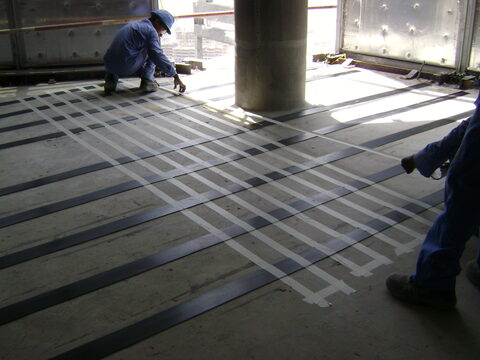
Why Parking Garages Need Strengthening
Parking structures fail in predictable ways: chloride-laden moisture penetrates the deck, corrodes the reinforcing steel, and spalls the cover concrete; post-tensioning losses reduce reserve capacity; and heavier modern vehicles, combined with changes in use, push aging slabs beyond their original design load. The critical members are the slab soffit in flexure, the column-slab junction in punching shear, and the beam edges in shear. Because parking garages must often stay in operation during strengthening, the retrofit must be lightweight, fast to install, and tolerant of damp, contaminated surfaces - a profile that suits externally bonded CFRP better than section enlargement or steel plating.
CFRP Systems for Slab Strengthening
Three CFRP interventions cover most garage slab cases. For flexural strengthening of the soffit, carbon fiber plate strips (FSL, pultruded, 1.2-3.0 mm thick, 50 or 100 mm wide, tensile strength 2400-2800 MPa) bonded in strips along the main span are the first choice - they deliver high modulus with a thin, low-profile bond line. For shear and confinement at column zones, or where geometry is irregular, carbon fiber fabric (FSC, wet lay-up) wrapped or fan-folded around the junction is preferred. For decks with active cracks, crack injection epoxy (FSE 523) restores monolithic behavior before the CFRP is applied. All three rely on FSE 302 epoxy primer for surface sealing and FSE 322 impregnating adhesive or FSE 362 plate adhesive for the bond.
Design Approach per ACI 440.2R
ACI 440.2R treats slab strengthening with the same strain-compatibility framework used for beams. For flexural gain, the CFRP contribution is added to the existing steel reinforcement, but the CFRP strain is limited to prevent debonding - typically 0.8 times the experimentally measured debonding strain, with an absolute cap. The designer must also check that the interface shear stress between the plate and the concrete stays below the bond limit, which usually governs the plate width and spacing. For punching shear at interior columns, ACI 440.2R provides a CFRP contribution term that supplements the concrete and steel shear capacity; the layout is a radial pattern of fabric strips or plates around the column. Always verify that the slab has enough residual capacity to hold the load if the CFRP were to debond - the ductile-failure check that prevents sudden collapse.
Installation Considerations for Operating Garages
Surface preparation is the make-or-break step. Remove delaminated concrete and exposed rebar corrosion products down to sound substrate, profile the surface to an ICRI CSP 3-5 texture, and dry the concrete so the moisture content is below 4% before priming. Apply FSE 302 primer to seal and strengthen the near-surface zone, then bed FSL plates in FSE 362 plate adhesive or saturate FSC fabric with FSE 322. Because decks are rarely perfectly flat, the thixotropic nature of FSE 362 lets it bridge minor undulations without sagging. Keep the area traffic-free until the adhesive reaches its full cure - typically 7 days at 23C, longer at lower temperatures - and use temporary protection sheets over the CFRP if vehicles must cross before full cure.
Worked Example: Soffit Flexural Upgrade
Consider a 200 mm thick one-way slab spanning 6 m, originally designed for 2.5 kPa live load, now required to support 4.0 kPa. The required additional moment capacity is roughly 22 kNm/m. Using FSL-1.4 plate (1.4 mm thick, 100 mm wide, Ef = 165 GPa) at a design strain of 0.006, each strip contributes about 0.14 x 165000 x 0.006 = 138 kN tensile force, with a lever arm near 175 mm, giving roughly 24 kNm per strip. At 300 mm spacing (3.3 strips per meter), the upgrade delivers about 80 kNm/m - comfortably above the 22 kNm/m required, with margin for the debonding and steel-yield checks. The plate is bonded with FSE 362 over FSE 302 primer, with a 100 mm staggered termination.
Frequently Asked Questions
How long before the slab can reopen to traffic?
The adhesive must reach full cure before the CFRP carries live load. At 23C this is about 7 days for FSE 322 and FSE 362. Below 15C, cure time roughly doubles; plan traffic closures accordingly or use a faster-cure variant.
Can CFRP carry wheel loads directly?
No. CFRP on the soffit works in tension, not as a wearing surface. The driving surface remains the original concrete deck; CFRP only adds capacity to the underside. For top-surface damage, repair the concrete and address corrosion first.
Does CFRP stop ongoing corrosion?
Not by itself. CFRP restores strength lost to corrosion but does not halt it. Address the chloride source, repair the concrete, and consider a waterproofing membrane on the deck surface as part of the project.