
What Tg Means for a Structural Epoxy
The glass transition temperature (Tg) of an epoxy is the temperature range over which the cured resin changes from a rigid, glassy solid to a softer, rubbery state. Below Tg the polymer network is stiff and load-bearing; above Tg the modulus drops sharply, creep accelerates, and the adhesive can no longer transfer force reliably between the carbon fiber and the substrate. For externally bonded CFRP systems, the adhesive's Tg therefore sets the upper bound on the service temperature the strengthening can sustain. Specifying a structural epoxy without confirming its Tg is one of the most common - and most consequential - oversights in CFRP projects.
Why Tg Governs CFRP Performance
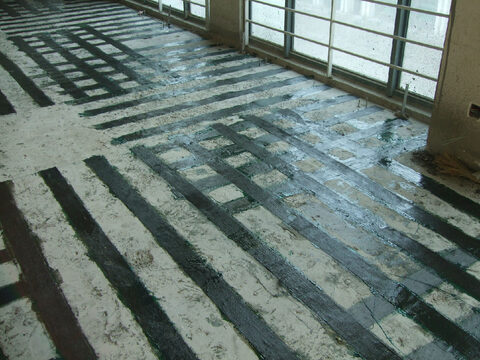
In a wet lay-up CFRP wrap, the impregnating epoxy does three jobs: it saturates the fabric, it bonds the composite to the concrete, and it transfers shear between fibers and substrate. All three depend on the resin staying stiff. When the resin temperature approaches Tg, its storage modulus can fall by an order of magnitude, the bond strength drops, and the effective strain in the fibers falls well below the ACI 440.2R design value. The result is a quiet loss of capacity that often goes unnoticed until a hot-day load event. Tg is not a marketing number - it is the temperature cliff the design must stay away from.
Code Requirements and the Tg Margin
ACI 440.2R requires that the maximum sustained service temperature of the strengthened member remain below the adhesive's Tg by a safe margin. The widely adopted convention is a 15C margin: the design service temperature should not exceed Tg minus 15C. ICC-ES acceptance criteria and GB 50367 take a similar position, requiring the adhesive Tg to be reported by DMA (ASTM E1640 / ISO 6721) and to exceed the design temperature by a defined amount. For most building interiors and sheltered exterior members, a Tg of at least 60C satisfies this rule against a typical 45C peak surface temperature.
FSE 322 Impregnating Adhesive: Tg at Least 60C
FidStrong FSE 322 is the impregnating structural epoxy used in wet lay-up of FSC carbon fiber fabric. It is formulated for site-applied wet lay-up, with a Tg of at least 60C when cured under standard conditions (7 days at 23C, or equivalent). This makes it suitable for the majority of building and bridge strengthening applications where design surface temperatures stay below 45C. For cooler-cure or faster-turnaround schedules, confirm the realized Tg by DMA on site-cured samples, because Tg is sensitive to the actual cure temperature and time - a resin rated Tg of at least 60C at 23C/7d will reach a lower Tg if cured at 10C.
Selecting the Right Adhesive by Service Temperature
| Design surface temperature | Required Tg (minimum) | Recommended system |
|---|---|---|
| Up to 40C (interior, shaded) | 55C | FSE 322 + FSE 302 epoxy primer |
| Up to 45C (exterior sheltered) | 60C | FSE 322 (standard cure) |
| Up to 55C (direct sun, dark surface) | 70C | FSE 322 with post-cure, or high-Tg variant |
| Above 55C (industrial hot zones) | per analysis | Consult FidStrong; consider mechanical protection |
For plate bonding, FSE 362 plate adhesive carries its own Tg rating - confirm it meets the same margin rule before specifying it for hot environments.
Verifying Tg on Site
Tg declared on a technical data sheet reflects a specific cure schedule. Site conditions rarely match exactly. For critical or hot-environment projects, cast beam samples of the actual mixed batch, cure them alongside the work, and test by DMA or DSC. A post-cure of 24-48 hours at 40-50C will raise the realized Tg of FSE 322 toward its full potential and is good practice when the design temperature approaches the Tg limit. Always record the cure history alongside the Tg result.
Frequently Asked Questions
Can I use an epoxy above its Tg?
Not for load transfer. Above Tg the bond and shear transfer degrade rapidly. If peak service temperature exceeds Tg minus 15C, either select a higher-Tg adhesive, add thermal protection, or derate the system substantially.
Does a faster cure lower the Tg?
Yes. Tg depends on degree of cure. A fast cure at low temperature leaves the network under-cured and the Tg lower than the TDS value. Always confirm Tg on samples cured under the actual site schedule.
What Tg do I need for fire-exposed structures?
Epoxy Tg alone cannot protect CFRP in a fire. For fire-rated members, combine a code-compliant adhesive with a fire-protection overlay sized for the required rating, and assume the CFRP is inactive during the fire event.