
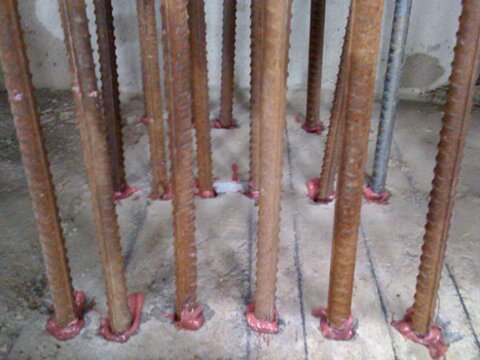
At a glance
- Two chemistries, two jobs: epoxy grades give the highest bond and compressive strength (80–110 MPa) on a normal schedule (~12 h cure at 23°C); a vinyl-ester hybrid cures far faster (30–90 min) and installs down to −5°C and in wet holes.
- A wet or water-saturated hole doubles the cure time — the single most-missed installation fact.
- The TDS load table is yield-based with no safety factor. It is not a design load; an engineer must apply the code’s reduction factors.
Choosing a post-installed anchoring adhesive comes down to matching the chemistry to your substrate, temperature, hole condition, and loading — and to remembering that the biggest variable in the field is not the adhesive but how clean and dry the hole is. This guide walks the selection logic for rebar-doweling and anchor adhesives, grounded in FidStrong FSFIX/FISFIX data sheets. For the resin fundamentals, see the structural epoxy adhesives guide.
Epoxy or vinyl-ester — which chemistry?
Two families cover most work. Epoxy anchoring adhesives (FISFIX 360/390/450/585/650) deliver the highest bond and compressive strength — 80 to 110 MPa depending on grade — and suit standard-schedule, heavily loaded doweling. A styrene-free vinyl-ester hybrid (FISFIX R360) trades some ultimate strength for speed and range: it cures in 30–90 minutes, installs from −5°C, and carries a seismic listing. Note the grade numbers are not a simple ranking — FISFIX 450 (100 MPa) outperforms the higher-numbered 585 (90 MPa), so select on the actual compressive strength, mix ratio, and cartridge size, not the number.
| Epoxy (FISFIX 360–650) | Vinyl-ester hybrid (R360) | |
|---|---|---|
| Compressive strength | 80–110 MPa | 82 MPa (ASTM D695) |
| Full cure | ~12 h at 23°C | 30–90 min (temp-dependent) |
| Install temperature | standard; service −40/+50°C | −5 to +40°C; service −40/+80°C |
| Seismic listing | not stated on TDS | ACI 355.4, categories C1/C2 |
| Best for | high load, standard schedule | fast turnaround, cold, wet holes |
How much load can it carry — and is that a design value?
Bond strength is real and grade-dependent: the epoxy adhesives develop about 11 MPa bond in C30 concrete and 18 MPa in C60 (Ø25 bar), higher-grade concrete giving higher bond as expected. But the load tables on the data sheet — capacity by bar diameter and embedment for C30, uncracked concrete — are yield-based values with no safety factor applied. They are not design loads. An engineer must apply the appropriate reduction factors from the governing code (e.g. ACI 318 or EN 1992) to arrive at a usable design capacity.
Can you anchor into cracked concrete or a wet hole?
Yes on both counts — the FSFIX/FISFIX line is stated suitable for cracked and uncracked concrete and for dry or water-saturated holes, and its thixotropic formulation holds in overhead and horizontal holes without sagging. The catch is timing: in a wet or saturated hole the full cure time doubles, so schedule the load accordingly and drain any standing water before cleaning. For cold or genuinely wet conditions, the fast-curing R360 hybrid is usually the better pick. Embedment depth across the line is a flexible 8d–12d (d = bar diameter).
Why hole cleaning is the make-or-break step
More anchors fail from a dirty hole than from the wrong adhesive. Drill dust left in the hole acts as a bond breaker, so the data sheets require a blow–brush–blow cycle repeated at least twice for the epoxy grades (at least three times for R360): compressed air (≤6 bar, oil- and water-free), a steel brush sized to the hole, then air again — and any water-filled hole must be drained first. Inject from the bottom of the hole upward to avoid trapping air, set the clean, oil-free bar with slow rotation, and leave it undisturbed to cure.
How does temperature affect installation?
Strongly, especially for the hybrid. The epoxy grades give roughly 40 minutes of work time and full cure in about 12 hours at 23°C, with a heat-deflection temperature of 66°C. The R360 hybrid’s working window is far more temperature-sensitive: 20 min at 10°C, 10 min at 20°C, 6 min at 30°C, and just 4 min at 40°C — so on a hot day you must mix small and set fast. Match the chemistry to the ambient: cold or urgent favours R360; warm and standard-schedule favours epoxy.
What should you demand from any supplier?
Beyond the data sheet, ask for code-recognized qualification. For anchors under a design code, a third-party evaluation — a US ICC-ES evaluation report (ESR) or a European Technical Assessment (ETA) — is what lets an engineer use published design values with confidence, and it is worth requesting from any supplier before you specify to a code. Also confirm the test method behind each number and whether a stated capacity is a yield value or a factored design value. Treat a bare strength number with no method and no evaluation report as marketing, not engineering data — the same scrutiny you would apply when qualifying any strengthening-material supplier.
FAQ
Do I need an epoxy or a vinyl-ester anchoring adhesive?
Use an epoxy grade (FISFIX 360–650) for standard-schedule work needing the highest bond and compressive strength (80–110 MPa, ~12 h cure at 23°C). Use the vinyl-ester hybrid R360 for fast turnaround, cold installation (down to −5°C), wet holes, or seismic work (ACI 355.4, categories C1/C2), where it cures in 30–90 minutes.
Can I anchor into cracked concrete or a wet drilled hole?
Yes to both — the FSFIX/FISFIX line is stated suitable for cracked and uncracked concrete and for dry or water-saturated holes. But full cure time doubles in a wet or saturated hole, and standing water must be drained before cleaning, so plan the load timing accordingly.
Is the load in the data-sheet table a design load?
No. The TDS load tables (C30, uncracked) are yield-based capacities with no safety factor applied. An engineer must apply the reduction factors from the governing code (ACI 318 or EN 1992) to get a usable design load — never anchor directly to the table number.
How important is hole cleaning?
It is the step most anchors fail on. The data sheets require a blow–brush–blow cycle at least twice for epoxy grades (three times for R360) with oil- and water-free air at ≤6 bar, plus draining any water first. Drill dust left in the hole is a bond breaker.
What embedment depth should I use?
The line allows a flexible 8d–12d (d = bar or rod diameter), set by the design load and the governing code — the deeper end for higher loads or where edge distance is limited. The specific value comes from the engineer’s anchor calculation, not a rule of thumb.
Is FidStrong’s anchoring adhesive ICC-ES listed?
Request current qualification documentation directly rather than assume it from the data sheet. For any code-governed anchor, an ICC-ES ESR or a European ETA is what allows an engineer to use recognized design values — ask every supplier for it before specifying to a code.
FidStrong manufactures the FSFIX/FISFIX anchoring adhesives and dispensing tools described here, plus carbon and glass-fiber rebar for corrosion-resistant doweling, under ISO 9001, 14001, and 45001 systems. Values here are from FSFIX/FISFIX data sheets; TDS load tables are yield-based, not factored design loads. Confirm the anchor design and every value against the governing code and a qualified engineer.