GFRP Rebar for Concrete Reinforcement
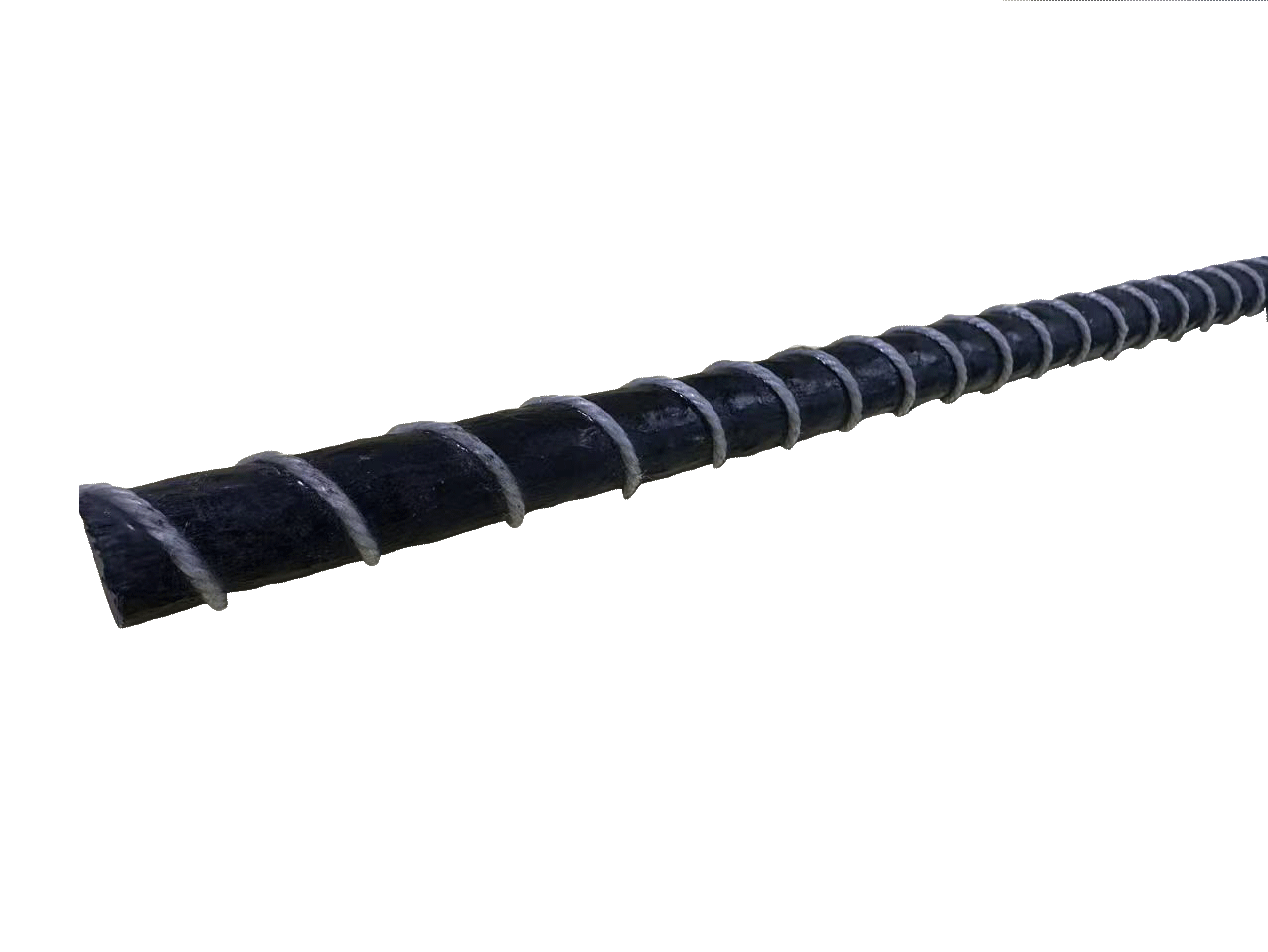
Pultruded S-glass bar in a vinyl-ester matrix. Non-corrosive, non-magnetic, about a quarter the weight of steel.
Specifications at a glance
GFRP rebar (glass fibre reinforced polymer rebar, also sold as fiberglass rebar or composite rebar) is a non-metallic reinforcing bar for concrete that cannot corrode. FidStrong, a Shanghai-based manufacturer of structural strengthening materials, supplies it as FSGR (ribbed) and FSGS (smooth) in Ø 6–32 mm and ships worldwide with a Mill Test Certificate and Certificate of Analysis for every batch.
FSGR and FSGS are pultruded glass-fibre reinforced polymer bars made from S-glass continuous roving in a vinyl-ester matrix, supplied ribbed or smooth in Ø 6–32 mm. Datasheet tensile strength is 950 MPa and tensile modulus 47 GPa, with tensile properties tested to ASTM D7205; the bars are also manufactured and tested to GB/T 26743-2011. At 2.1 g/cm³ the bar weighs about a quarter of steel of the same diameter, carries no corrosion risk from chloride, carbonation or alkali, and is neither electrically conductive nor magnetic.
| Property | Value |
|---|---|
| Models | FSGR (ribbed) / FSGS (smooth) |
| Diameter | Ø 6 / 8 / 10 / 12 / 14 / 16 / 20 / 22 / 25 / 28 / 32 mm |
| Fibre | S-glass continuous roving, min 70% by weight |
| Resin Matrix | Vinyl-ester |
| Tensile Strength | 950 MPa (datasheet value, ASTM D7205) |
| Tensile Elastic Modulus | 47 GPa (datasheet value, ASTM D7205) |
| Elongation at Break | 2.1% (ASTM D7205) |
| Density | 2.1 g/cm³ (about 1/4 of steel) |
| Corrosion | Non-corrosive — immune to chloride, carbonation and alkali attack |
| Electromagnetic | Non-conductive, non-magnetic |
| Packaging | 6 m and 12 m straight bars; bent shapes to order |
| Shelf Life | 2 years from manufacture, stored flat and out of direct sunlight |
Where is GFRP rebar used?
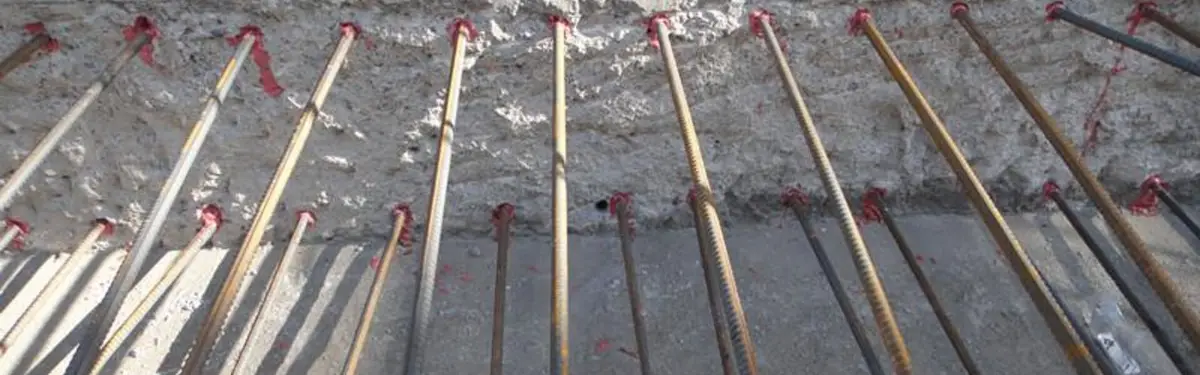
Marine and coastal structures
Quay walls, jetties, sea-walls and splash-zone slabs, where chloride reaches the reinforcement and decides the service life of the structure.
Bridge decks and parapets
Elements that take de-icing salt every winter. The salt still arrives; there is simply nothing in the bar for it to attack.
Chemical, wastewater and desalination plants
Tanks, channels and slabs in contact with aggressive process water, where the concrete cover alone was never going to protect steel for the design life.
MRI suites, substations and radar foundations
Places where steel is not permitted at all. The bar is non-conductive and non-magnetic, so it does not distort a field or carry a current.
Tunnel soft-eye sections
Temporary walls a tunnel boring machine has to cut through. GFRP is cuttable by the TBM in a way steel is not, which is why the soft eye is reinforced with it.
Permanent works with a long design life
Any member where corrosion, not strength, is what limits how long it lasts — and where a repair later would cost more than the bar does now.
FSGR or FSGS — and how does GFRP compare with steel rebar?
| Model | Surface | Choose it when |
|---|---|---|
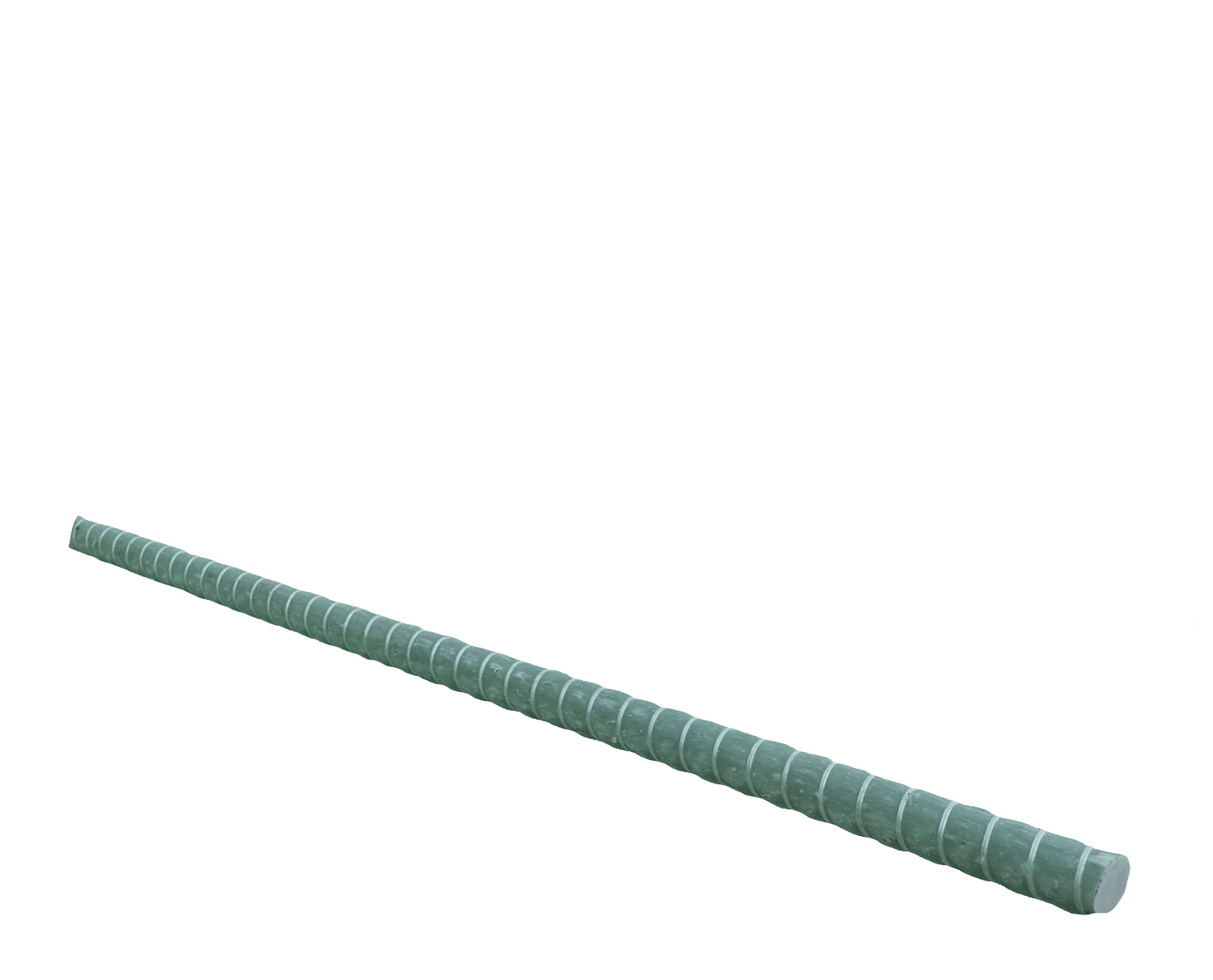
| FSGR | Ribbed — surface ribs along the bar | The default for structural reinforcement. The ribs develop mechanical bond with concrete by interlocking, the same way a deformed steel bar does. Bent shapes are available, factory-formed to order. |
| FSGS | Smooth — plain round, as-pultruded | Where bond is not the governing action, or where a clean round surface is wanted for handling or for a site-applied surface treatment. Mechanical properties are identical to FSGR. |
| Against steel rebar | GFRP (FSGR / FSGS) | What it changes for you |
|---|---|---|
| Corrosion | None — immune to chloride, carbonation and alkali | This is the whole reason to use it. Where steel corrosion decides service life — marine, de-icing salt, wastewater, desalination — the failure mode simply is not there. |
| Weight | 2.1 g/cm³ against 7.85 for steel | About a quarter the weight per metre. Fewer people to place it, cheaper freight, and a 12 m bar one worker can carry. |
| Strength | 950 MPa tensile (datasheet) against 400 MPa steel yield | More than twice the headline number — but read the design table below before you use it. Code factors take a large bite out of it. |
| Stiffness | 47 GPa against about 200 GPa for steel | The one that catches people out. At roughly a quarter of steel's modulus, deflection and crack width usually govern the design, not strength. |
| Ductility | Linear-elastic to failure, 2.1% elongation — no yield plateau | GFRP does not yield, so sections are normally designed compression-controlled (concrete crushes first) rather than tension-controlled. The balanced ratio is about 0.0078 against 0.0335 for steel (ACI 440.1R-15 Table 7.2.1, f'c = 34.5 MPa). |
| Electromagnetic | Non-conductive, non-magnetic | MRI suites, substations, radar and antenna foundations, rail signalling — places where steel is not allowed at all. |
Both models come as 6 m and 12 m straight bars; bends are factory-formed to order because GFRP cannot be bent on site — the resin is already cured. Shelf life is 2 years from manufacture, stored flat on supports, off the ground and out of direct sunlight.
The values on this page are material properties from our datasheet, not design values. GFRP-reinforced concrete is designed to ACI 440.1R / ACI 440.11 or the local equivalent, and the code applies reductions the datasheet does not show — see the second table below. The TDS states it plainly: design calculations must be certified by an independent licensed professional engineer.
What do the bars weigh, and what design values does ACI 440.1R give?
Bar sizes and shipping weight
| Bar Ø (mm) | Nominal area (mm²) | GFRP (kg/m) | Steel of same Ø (kg/m) | 12 m bar (kg) | Nearest ASTM bar No. (nominal Ø) |
|---|---|---|---|---|---|
| 6 | 28.3 | 0.059 | 0.222 | 0.7 | #2 (6.3 mm) |
| 8 | 50.3 | 0.106 | 0.395 | 1.3 | — |
| 10 | 78.5 | 0.165 | 0.617 | 2.0 | #3 (9.5 mm) |
| 12 | 113.1 | 0.238 | 0.888 | 2.9 | #4 (12.7 mm) |
| 14 | 153.9 | 0.323 | 1.208 | 3.9 | — |
| 16 | 201.1 | 0.422 | 1.578 | 5.1 | #5 (15.9 mm) |
| 20 | 314.2 | 0.660 | 2.466 | 7.9 | #6 (19.1 mm) |
| 22 | 380.1 | 0.798 | 2.984 | 9.6 | #7 (22.2 mm) |
| 25 | 490.9 | 1.031 | 3.853 | 12.4 | #8 (25.4 mm) |
| 28 | 615.8 | 1.293 | 4.834 | 15.5 | #9 (28.7 mm) |
| 32 | 804.2 | 1.689 | 6.313 | 20.3 | #10 (32.3 mm) |
Area is the nominal circular area πd²/4; mass uses the datasheet density 2.1 g/cm³ (steel at 7.85 for comparison). Use these for freight and handling, not for design — the ASTM specification for GFRP bars assigns its own nominal area to each bar number, and the design area must come from the mill certificate of the bars you actually receive. ASTM bar numbers in the last column are the nearest designation by nominal diameter; the ASTM nominal area for that number differs from πd²/4 of our metric bar.
From datasheet number to design number (ACI 440.1R-15)
| Environmental factor CE | Design ffu (MPa) | Sustained load limit (MPa) | At a 90° bend, rb/db = 4 (MPa) | Shear stirrup limit (MPa) | Share of the 950 headline |
|---|---|---|---|---|---|
| 0.8 | 760 | 152 | 380 | 188 | 80% |
| 0.7 | 665 | 133 | 333 | 188 | 70% |
CE 0.8 is concrete not exposed to earth and weather, CE 0.7 is exposed (Table 6.2). Design strength is ffu = CE × ffu* (Eq. 6.2a) with the datasheet 950 MPa taken as ffu* (a datasheet value, not a per-size guaranteed value — see the quality-check note). Sustained-plus-fatigue stress is capped at 0.20 ffu for glass fibre (Table 7.4.1, safety factor already included). A 90° bend keeps 0.50 ffu at rb/db = 4 (Eq. 6.2.1). Shear stirrups are limited by a 0.004 strain cap, ffv = 0.004 Ef (Eq. 8.2d).
Read the two right-hand columns of the second table together: a bar advertised at 950 MPa is limited to 133 MPa under sustained load in an exposed element once the code factors are applied — about a seventh of the headline. That is not a defect in the product, it is how GFRP is designed everywhere, and any supplier quoting you a headline number without this context is not doing you a favour. Section design, deflection and crack-width checks belong to the project engineer.
How is GFRP rebar placed on site? Six steps
Order the bends with the bar
GFRP cannot be bent on site. The resin is cured; forcing a bend cracks the matrix and the bar loses its strength without necessarily looking damaged. Stirrups, hooks and bent bars are factory-formed, so shapes and quantities have to be settled at order stage, not at the site.
Store it flat and shaded
Keep bundles on flat supports off the ground, protected from impact and prolonged UV. Shelf life is 2 years from manufacture under proper storage. Dragging bars across a slab chews the ribs, and the ribs are what develop bond.
Cut, never weld or heat
Cut to length with an abrasive disc or a fine-tooth blade; wear eye protection and a dust mask, and follow the SDS for handling glass dust. Cut ends do not need sealing for corrosion — there is nothing in the bar to corrode — but keep them out of the anchorage zone where full bond length matters.
Tie with plastic or coated ties
Use plastic clips or coated wire. Bare steel tie wire in contact with the bar defeats part of the reason you chose GFRP, and steel chairs or spacers put a corrosion path right back into the cover zone. Use plastic or fibre-reinforced supports.
Respect the cover and the lap
GFRP develops bond differently from steel: laps are typically much longer, and ACI 440.1R recommends embedment in the 20–100 bar-diameter range depending on cover and bar size (Eq. 10.3a). Do not carry over a steel lap length from habit — take it from the GFRP calculation for your section.
Pour and check as usual
Placing, vibrating and curing are the same as for steel-reinforced concrete. Because the bar floats — it is a quarter of steel's weight — check that supports and ties actually hold position before and during the pour.
Frequently Asked Questions
Can GFRP rebar replace steel one-for-one?
No, and any supplier who says otherwise is selling you a problem. The bar is stronger than steel but roughly four times less stiff, and it has no yield plateau. That changes which limit state governs: deflection and crack width usually control, sections are designed compression-controlled rather than tension-controlled, and the balanced reinforcement ratio is about 0.0078 against 0.0335 for steel (ACI 440.1R-15 Table 7.2.1, f'c = 34.5 MPa). The section has to be redesigned to ACI 440.1R / ACI 440.11 or the local equivalent, not substituted.
Why is the design strength so much lower than 950 MPa?
Because the code says so, for every GFRP bar from every supplier. Design strength is the environmental factor times the guaranteed strength (0.8 or 0.7, ACI 440.1R-15 Table 6.2), and sustained plus fatigue stress is then capped at 0.20 of that for glass fibre (Table 7.4.1). In an exposed element that leaves about 133 MPa. The table above shows the arithmetic so you are not surprised by it at design stage.
Can it be bent or cut on site?
Cut yes, bend no. The resin is already cured, so a site bend cracks the matrix and the bar loses strength without necessarily looking damaged. All bends, stirrups and hooks are factory-formed to order — which means the bar schedule has to be settled before manufacture, not adjusted on site.
Does a bend weaken the bar?
Yes, and the code quantifies it: strength at the bend is (0.05 × rb/db + 0.3) × ffu, so at a bend radius of four bar diameters the bend carries half of the straight-bar design strength (ACI 440.1R-15 Eq. 6.2.1). Bends have to be checked on that reduced value, not on the straight-bar figure.
How does it behave in a fire?
Worse than steel, and it needs to be assessed for the specific case. The vinyl-ester matrix softens near its glass transition temperature, and once the matrix goes the bar cannot transfer stress into the fibres. Cover, member type and required fire rating decide whether GFRP is acceptable at all — that is a project-specific assessment by the engineer, not something a datasheet answers.
What is the difference between FSGR and FSGS?
Surface only. FSGR has ribs along the bar and develops mechanical bond with the concrete through rib interlocking, the way a deformed steel bar does; FSGS is plain round, as pultruded. The fibre, resin, strength, modulus and density are identical. For structural reinforcement the ribbed bar is the default.
Which standards is it made and tested to?
Tensile properties are tested to ASTM D7205 (test method for tensile properties of FRP composite bars) and the bars are manufactured and tested to GB/T 26743-2011. We do not currently hold a full ASTM D7957 qualification file (Tg, degree of cure, transverse shear, bond, moisture absorption, alkali retention); if your specification requires D7957, tell us at enquiry stage and we will state plainly which items we can document. Design is a separate matter: ACI 440.1R-15 is the guide and ACI 440.11-22 is the first GFRP building code written in mandatory language alongside ACI 318.
Do you have a third-party product approval for it?
No. The bars ship against their own technical data sheets with the properties tested to the ASTM methods above, plus a Mill Test Certificate and Certificate of Analysis for the batch. If your specification calls for a particular third-party approval, tell us at enquiry stage and we will say plainly whether we can meet it.
Documents & Downloads
Two datasheets, one per surface
FSGR for the ribbed bar and FSGS for the smooth bar. Both carry the full property table with the ASTM test method against each value.
MTC + COA with every shipment
Every batch ships with a Mill Test Certificate and a Certificate of Analysis. Ask for them at order stage if your specification needs them filed.
Request a Quote
Send the diameters, lengths and quantities — and the bends, because those are factory-formed. An engineer comes back within one working day with the quote, the weights for your freight calculation and the datasheets. If your section still has to be designed for GFRP, say so and we will tell you what the engineer will need.