
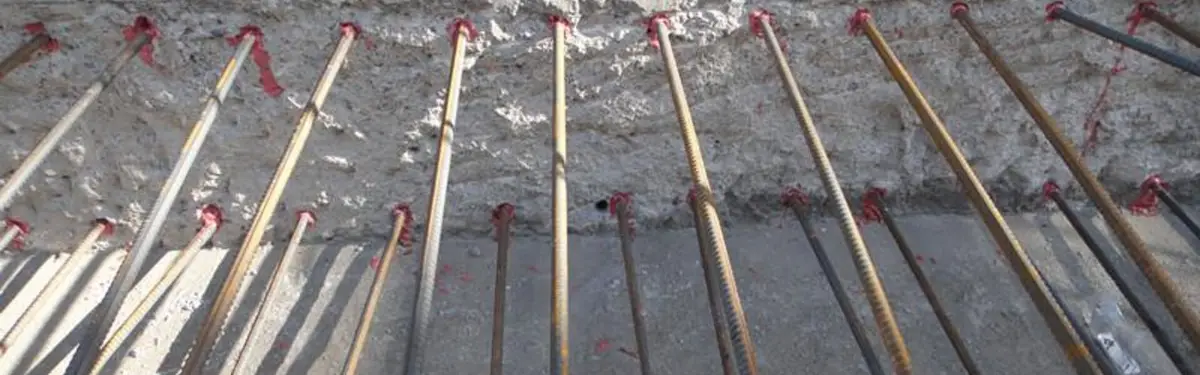
Chemical Anchoring Adhesive for Rebar & Threaded Rod
High-strength epoxy anchoring systems for rebar installation and post-installed connections.

Specifications at a glance
Two-component, high-performance epoxy-based chemical anchoring adhesive supplied in side-by-side cartridges with integrated static mixer. FISFIX is engineered for post-installed rebar connections, threaded rod anchoring, and structural dowelling in concrete, masonry, and natural stone. Its thixotropic formulation allows overhead and horizontal installation without drip. Styrene-free and VOC-compliant, suitable for cracked or uncracked concrete, dry or damp holes.
| Property | Value |
|---|---|
| Models | FISFIX 360 / 390 / 450 / 585 / 650 / FISFIXR 360 |
| Cartridge (FISFIX 360) | 360 mL, side-by-side with static mixer |
| Mix Ratio | 5:1 (by volume) |
| Colour (Mixed) | Grey / Pink |
| Compressive Strength | ≥ 80 MPa |
| Flexural Strength | ≥ 55 MPa |
| Splitting Tensile | ≥ 20 MPa |
| Tensile Modulus | ≥ 3,500 MPa |
| Elongation | ≥ 0.3% |
| Bond — C30 Concrete | ≥ 11 MPa (Φ25, L=150 mm) |
| Bond — C60 Concrete | ≥ 18 MPa (Φ25, L=125 mm) |
| Service Temperature | -40 / +50°C |
| Working Time (23°C) | 40 min |
| Full Cure (23°C) | 12 h |
| Density (Cured) | 1.6 g/cm³ |
| Shelf Life | 12 months (unopened, +5 to +25°C) |
Where It Is Used
Post-installed rebar connections
Starter bars, dowels and slab or wall extensions tied into existing concrete — the everyday use, and the one the load tables are written for.
Structural steel to concrete
Threaded rod for safety barriers, canopies, signage, handrails, racking, machinery bases and stadium seating.
Masonry and hollow substrates
Solid or hollow brick and block, and natural stone — hollow substrates need a sleeve so the resin forms a key instead of running away.
Overhead and horizontal holes
The thixotropic formulation (index ≥ 4.2, sag ≤ 1.4 mm at 25 °C) holds in the hole instead of dripping out.
Cold and damp conditions
Sets in dry or damp drill holes and works down to −10 °C substrate; double the cure time for water-saturated holes.
Selection Guide
| Model | Cartridge & mix | Choose it when |
|---|---|---|
| FISFIX 360 | 360 mL · 5 : 1 · 80 MPa | The everyday cartridge for post-installed rebar and threaded rod. Service range −40 / +50 °C. |
| FISFIX 390 | 390 mL · 3 : 1 · 90 MPa | Same job, more resin per cartridge and a higher compressive figure — fewer cartridge changes on a long run. |
| FISFIX 450 | 450 mL · 2 : 1 · 100 MPa | Heavy-duty connections. Note the narrower service range: −20 / +40 °C, not −40 / +50. |
| FISFIX 585 | 585 mL · 3 : 1 · 90 MPa | The 390 formulation in a large cartridge — for big-diameter bars where each hole swallows 130–270 mL. |
| FISFIX 650 | 650 mL · 1 : 1 · 110 MPa | Highest compressive strength and the largest cartridge; for high-load structural connections. |
| FISFIX R360 | 360 mL · 5 : 1 · 82 MPa | Vinyl-ester hybrid, styrene-free. Working time about 10 min at 20 °C — choose it when you need to load fast, not when you need long open time. |
| Chemistry | What it is | When to choose it |
|---|---|---|
| Epoxy | FISFIX 360 / 390 / 450 / 585 / 650 · 80–110 MPa compressive | Default for structural anchorages. Longer open time (30–40 min at 23–30 °C), sets in dry or damp holes, and the whole load-table range below is built on it. |
| Vinyl-ester hybrid | FISFIX R360 · 82 MPa compressive, styrene-free | When the hole has to carry load the same shift. About 10 min working time at 20 °C — plan the batch size before you pull the trigger. |
Cartridges are side-by-side with an integrated static mixer and need the matching dispensing gun; the first 10–15 cm out of a fresh nozzle is discarded until the colour is uniform. Work out the cartridge count from the epoxy volume per hole in the load tables below — a Ø16 bar at 160 mm takes about 33 mL, so one 360 mL cartridge does roughly ten holes.
The load values below are at bar or rod yield with no safety factor applied, measured in C30 uncracked concrete. They are a supply reference, not a design. Anchor design belongs to the project engineer under the governing code (ACI 318 Ch. 17, EN 1992-4 or local equivalent), and cracked-concrete, seismic and fire cases each need their own assessment.
Load Capacity Tables
Post-installed rebar — C30 concrete, uncracked
| Bar Ø (mm) | Hole Ø (mm) | Min depth (mm) | Epoxy (mL) | Grade 40 (kN) | Grade 60 (kN) |
|---|---|---|---|---|---|
| 8 | 12 | ≥ 100 | 7.5 | 14.1 | 20.8 |
| 10 | 14 | ≥ 100 | 10.3 | 22.0 | 32.6 |
| 12 | 15 | ≥ 120 | 14.1 | 31.7 | 46.9 |
| 16 | 20 | ≥ 160 | 33.5 | 56.3 | 83.4 |
| 18 | 22 | ≥ 180 | 45.6 | 71.2 | 105.6 |
| 20 | 25 | ≥ 200 | 65.4 | 87.9 | 130.3 |
| 25 | 32 | ≥ 250 | 134.0 | 137.4 | 203.6 |
| 28 | 35 | ≥ 280 | 179.5 | 172.3 | 255.4 |
| 32 | 40 | ≥ 320 | 267.9 | 225.1 | 333.6 |
Grade 40 = 280 MPa yield, Grade 60 = 415 MPa yield. Embedment depths run 8d to 12d; the figures above are the minimum.
Threaded rod — C30 concrete, uncracked
| Rod Ø (mm) | Hole Ø (mm) | Min depth (mm) | Epoxy (mL) | Grade 5.8 (kN) | Grade 8.8 (kN) |
|---|---|---|---|---|---|
| 8 | 12 | ≥ 100 | 7.5 | 20.1 | 32.2 |
| 10 | 14 | ≥ 100 | 10.3 | 31.4 | 50.2 |
| 12 | 14 | ≥ 120 | 12.3 | 45.2 | 72.3 |
| 16 | 18 | ≥ 160 | 27.1 | 80.4 | 128.6 |
| 20 | 24 | ≥ 200 | 60.3 | 125.6 | 201.0 |
| 22 | 25 | ≥ 220 | 72.0 | 152.0 | 243.2 |
| 24 | 28 | ≥ 240 | 98.5 | 180.9 | 289.4 |
| 27 | 30 | ≥ 270 | 127.2 | 228.9 | 366.2 |
| 30 | 35 | ≥ 300 | 192.3 | 282.6 | 452.2 |
| 36 | 42 | ≥ 360 | 332.3 | 406.9 | 651.1 |
| 39 | 45 | ≥ 390 | 413.3 | 477.6 | 764.2 |
Grade 5.8 = 400 MPa yield, Grade 8.8 = 640 MPa yield. Epoxy usage is based on filling two thirds of the drill hole.
Figures are from the FISFIX 360 technical data sheet. Double the cure time for water-saturated holes, and remember that minimum concrete age is 28 days. Ask for the TDS of the model you are quoting — the tables differ between cartridges.
Installation in Six Steps
Drill the hole
Rotary percussion drill and a carbide-tipped bit, to the diameter and depth in the table above. Concrete must be at least 28 days old and frost-free.
Clean the hole
Blow out the dust with oil- and water-free compressed air at 6 bar or more, brush with a steel brush, then blow again — at least two full blow-brush-blow cycles. This is the step that fails anchors: drilling dust left in the hole is the most common reason a pull-out test comes back short.
Prepare the cartridge
Fit the static mixing nozzle and dispense to waste until the colour runs uniform with no streaking. Pre-condition the cartridge above 10 °C if you are dispensing by hand.
Fill from the back
Push the nozzle to the bottom of the hole and fill from the bottom up, about one half to three quarters full, withdrawing the nozzle steadily so no air is trapped.
Set the bar
Push the clean, oil-free rebar or rod in with a slow twisting motion. Resin should be expelled evenly around the mouth of the hole — that is your sign the hole was full. Strike off the excess before it sets.
Let it cure
Do not disturb the anchor while it cures: 6 h at 30 °C, 12 h at 23 °C, 48 h at 10 °C. Then torque to the specified value — do not overtighten.
Frequently Asked Questions
What is the difference between a chemical anchor and a mechanical anchor bolt?
A mechanical anchor holds by friction — an expansion sleeve or wedge pressing against the side of the hole. A chemical anchor holds by bond: the resin fills the annulus and transfers load along the whole embedded length. That is why chemical anchoring works at smaller edge distances and closer spacings, and why it is the method for post-installed rebar. We supply the adhesive, not the bolt.
Which model should I order?
For ordinary post-installed rebar and threaded rod, FISFIX 360. Move to FISFIX 390 or 585 when you want more resin per cartridge, to FISFIX 450 or 650 for high-load connections, and to FISFIX R360 when the anchor has to carry load the same shift. Send us the bar diameter, the embedment and the number of holes and we will tell you the cartridge count.
How much adhesive does one hole take?
It is in the load tables above, per diameter — 7.5 mL for a Ø8 bar at 100 mm, 33.5 mL for Ø16 at 160 mm, 268 mL for Ø32 at 320 mm. The figures assume the hole is filled to about two thirds. One 360 mL cartridge does roughly ten Ø16 holes.
Can I use it in a damp or wet hole?
Yes — the epoxy sets in dry or damp drill holes. For water-saturated holes, double the cure time. What it cannot do is set on a frozen substrate, and it cannot rescue a dirty hole.
How deep does the bar have to go?
Embedment runs from 8d to 12d depending on the load, and the minimum depths per diameter are in the table above. The actual depth is a design decision by your engineer under the governing code, not a number to copy from a supplier page.
How long before I can load the anchor?
Full cure is 6 h at 30 °C, 12 h at 23 °C and 48 h at 10 °C for FISFIX 360, and open time before gel is 30–40 min in the same range. Double it for water-saturated holes. FISFIX R360 is the fast option — about 10 min working time at 20 °C.
Is it suitable for cracked concrete?
The FISFIX 360 datasheet states suitability for cracked and uncracked concrete, but the load tables on this page are measured in uncracked C30. Cracked-concrete, seismic and fire design cases each need their own assessment under your code — do not read across from these tables.
What approvals do you have?
Tell us which approval your specification calls for — ETA, ICC-ES, or a local equivalent — and we will confirm in writing what we can provide for your market before you order, rather than after. What ships as standard with every batch is the TDS, a Mill Test Certificate and a Certificate of Analysis.
What is the shelf life, and how should it be stored?
12 months from manufacture, unopened, at +5 to +25 °C, out of direct sunlight. Pre-condition to about 23 °C before dispensing — cold cartridges are hard work with a hand gun. Do not thin with solvents; solvent stops it curing.
Do you do OEM or private label?
Yes. Cartridges, nozzles, labels and cartons can be produced under your own brand — that is a large part of what we do. Send the volume and the artwork requirement and we will come back with the tooling and MOQ position.
Documents & Downloads
TDS for every model
Each FISFIX cartridge has its own technical data sheet with the full property table, working and cure times by season, and its own load tables.
MTC + COA with every shipment
Every batch ships with a Mill Test Certificate and a Certificate of Analysis.
Request a Quote
Send the bar diameter, the embedment depth and how many holes — an engineer comes back within one working day with the cartridge count, the quote and the matching TDS.


