
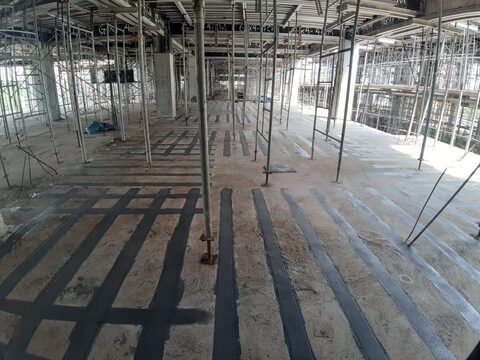
At a glance
- The big three: a weak or dirty substrate, incomplete wet-out (air not rolled out before gel), and a cold joint from running out of resin mid-bay — all cause debonding.
- Know the pass/fail line: a pull-off test passes only above 200 psi (1.4 MPa) and failing inside the concrete, not at the bond.
- Grade voids by size: under 2 in² may be left, 2–25 in² is injected, 25 in²+ is cut out and patched.
Almost every CFRP installation failure is a debonding failure, and almost every debonding failure traces to a handful of avoidable field mistakes. This guide walks the ones that actually cause trouble — and the correct number or practice for each — drawn from FidStrong data sheets, ACI SPEC-440.12-22, and a real field case. It complements the full installation guide.
What is the single biggest installation mistake?
Incomplete wet-out — not rolling the entrained air out of the fabric before the resin gels. ACI 440.2R requires air to be worked out with a ribbed roller before gel so the fiber is fully saturated; skip it and you get voids and delamination. Its worst form is running out of resin partway through a bay and topping it off hours later: once the underlying resin has gelled, fresh resin only films the surface — it cannot penetrate the fibers already locked dry, leaving a weak cold joint rather than a structural laminate.
Which substrate mistakes cause debonding?
The ones made before any fiber goes down. Leaving laitance, oil, or a smooth un-profiled face starves the bond: the substrate must be mechanically abraded to a minimum CSP 3 profile and reach a pull-off strength of at least 1.5 MPa (FidStrong TDS; ACI’s floor is 1.4 MPa / 200 psi). Installing on a substrate that only looks dry is another: moisture content must be below 4% (ASTM D4263), because vapor driving through the uncured resin blisters the laminate and destroys the bond. The full method is in surface preparation for CFRP.
Which timing and technique mistakes matter?
Three. Applying the saturating resin outside the primer’s 2–24 hour recoat window — too late, over fully cured primer — kills the chemical bond between coats. Not rolling air out before the resin gels (above) leaves voids. And on multi-ply builds, adding a ply over a fully cured layer without mechanically abrading and solvent-wiping it first repeats the cold-joint problem between plies — layers should go on wet-on-wet. The saturating epoxy’s pot life shrinks sharply in heat, so plan batch sizes accordingly.
Which detailing mistakes get missed?
The small ones that quietly initiate debonding. Laying fabric more than ±5° off the specified axis loses strength along the load direction (ACI SPEC-440.12-22). Wrapping a sharp corner instead of rounding it to R ≥ 20 mm creates a stress concentration that cuts the fiber. Laying fabric over a crack wider than 0.3 mm that should have been epoxy-injected first lets it propagate under the laminate. And leaving cured carbon bare outdoors — no quartz-sand-and-topcoat UV protection — degrades the resin. Work only within +5 to +35 °C and above the dew point.
How do you catch problems — QC and defect repair?
By testing, not eyeballing. On bond-critical work, pull-off test to ASTM D7522 at 3 tests per 1,000 ft² (minimum 3 per day); a pass needs both > 200 psi and failure inside the concrete — a high number that breaks at the bond line is a fail. After cure, sound the laminate (tap or infrared) and grade each void by measured area: under 2 in² may be left within tolerance, 2–25 in² gets low-pressure epoxy injection, and 25 in² or larger is cut out and patched with engineer approval. Diagnose blisters by timing — bubbling while wet is trapped air; a scatter appearing during cure points to substrate moisture.
FAQ
What’s the single biggest cause of CFRP debonding?
Incomplete wet-out — air or dry fiber not rolled out before the resin gels (ACI 440.2R). In real cases, resin running out mid-bay and being topped off hours later is the classic trigger: the old resin has gelled, so the patch only bonds superficially, not structurally.
I ran out of resin partway through a bay — can I finish it later?
No, not once the first pour has gelled. Fresh resin films over cured resin but can’t penetrate the dry fiber underneath. Tap-test to map the under-saturated zone, cut it out, and re-lay that section in one continuous wet-on-wet pass — documented from a real field case.
How big a void is acceptable in a finished layup?
Under 2 in² (about 13 cm²) is acceptable only if total debonded area stays under 5% of the laminate and no more than 10 spots per square metre — otherwise it must be epoxy-injected. Anything 25 in² (160 cm²) or larger must be cut out and patched.
How do I tell if a blister is trapped air or a moisture problem?
Tap it: a hollow sound confirms a void. Timing narrows the cause — bubbling while the resin is still wet points to entrapped air or unfilled pinholes; a scatter of small blisters appearing during cure points to substrate moisture vapor. Puncture to confirm before choosing a repair.
What pull-off strength should installation QC target?
Greater than 200 psi (about 1.4 MPa), with failure occurring inside the concrete itself, not at the bond line — both conditions must be met. Test at 3 pulls per 1,000 ft² of installed area, minimum 3 per day (ACI SPEC-440.12-22).
Does fiber alignment really matter if it’s off by a few degrees?
Yes. CFRP develops strength only along the fiber axis, and installation tolerance is capped at ±5° from the specified direction. Exceeding it isn’t automatically a fail, but it requires the engineer of record to re-check capacity before the work is accepted.
Prevent most of these upstream with proper surface preparation and curing control; for the fundamentals, see what CFRP strengthening is.
FidStrong manufactures FSC carbon fabric and the FSE primer, saturating, and repair epoxies referenced here, under ISO 9001, 14001, and 45001 quality systems. Practices and figures are drawn from the product data sheets, ACI 440.2R, and ACI SPEC-440.12-22; follow the project specification and a qualified engineer’s requirements.