
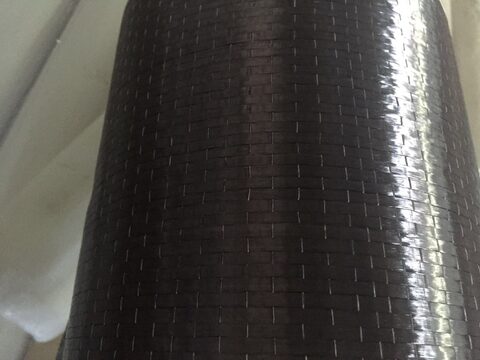
Why Confinement Matters for Concrete Columns
When an axial load pushes a concrete column toward failure, the concrete dilates laterally and eventually crushes. Wrapping the column with carbon fiber fabric creates passive confinement: as the core dilates, the CFRP jacket develops hoop tension that restrains that dilation. The result is a triaxial stress state that raises both compressive strength and, just as importantly, deformation capacity. For seismic retrofits and load-capacity upgrades, that added ductility is often the governing design objective.
The ACI 440.2R Confinement Model
ACI 440.2R, the "Guide for the Design and Construction of Externally Bonded FRP Systems for Strengthening Concrete Structures," gives the most widely used confinement model. For a circular column, the confined compressive strength of the core is:
f'cc = f'co + 3.3 . ka . f'l
where f'co is the unconfined concrete strength, ka is a shape/efficiency factor (1.0 for a well-confined circular section), and f'l is the effective lateral confining pressure supplied by the CFRP jacket. The lateral pressure is:
f'l = 2 . n . tf . Efu . efe / D
Here n is the number of carbon fiber layers, tf is the nominal thickness per layer, Efu is the fiber elastic modulus, efe is the effective design strain of the fibers, and D is the column diameter. Rearranging to solve for the required number of layers gives:
n = (f'l . D) / (2 . tf . Efu . efe)
The key discipline is selecting efe. ACI 440.2R caps the effective strain to prevent jacket rupture and to account for the strain lag between the fibers and the dilating core. For strength design of circular columns, efe is typically limited to 0.004.
Step-by-Step Calculation: A Worked Example
Suppose a 500 mm diameter circular column with f'co = 30 MPa must be upgraded to f'cc = 42 MPa. We specify FidStrong FSC-300A carbon fiber fabric (PAN-based, T700, 300 g/m2), with a nominal thickness per layer tf = 0.167 mm, elastic modulus Efu = 230 GPa, and tensile strength of at least 3400 MPa.
- Required lateral pressure. From f'cc = f'co + 3.3 . ka . f'l with ka = 1.0: f'l = (42 - 30) / 3.3 = 3.64 MPa.
- Effective strain. Use efe = 0.004 per ACI 440.2R strength design.
- Solve for layers. n = (3.64 . 500) / (2 . 0.167 . 230000 . 0.004) = 1820 / 307.3, which is about 5.9. Round up to 6 layers.
- Verify the jacket ratio. With 6 layers the delivered f'l = 2 . 6 . 0.167 . 230000 . 0.004 / 500 = 3.69 MPa, giving f'cc of about 42.2 MPa. The design checks.
For a ductility-only target (no strength gain required), ACI 440.2R lets you use a higher efe and fewer layers, because the jacket only needs to mobilize at large strains. Always confirm which limit state governs before finalizing n.
Rectangular Columns and the Shape Factor
Confinement is far less efficient in square or rectangular columns because the jacket arches over the corners and leaves poorly confined zones along the flat faces. ACI 440.2R accounts for this with efficiency factors ka and kb, both less than 1.0, that depend on the corner radius rc and the section dimensions. As a practical rule, rectangular sections need a minimum corner radius of 25 mm (achieved by grinding or mortar profiling) and typically require 30-60% more material than an equivalent-area circular column for the same strength gain. For very slender or sharply rectangular sections, consider FRCM or steel jacketing instead.
Material Selection and Installation
Confinement wraps use unidirectional fabric oriented with the fibers perpendicular to the column axis (the 0 degree hoop direction). FSC-300A (300 g/m2, A-grade, T700) is the workhorse grade for columns; FSC-200C (200 g/m2, C-grade, T300) suits lighter ductility upgrades. Each layer is saturated with structural epoxy - FSE 322 impregnating adhesive (Tg of at least 60C) - applied by wet lay-up over an FSE 302 epoxy primer. Provide a minimum 100 mm fabric overlap at the termination to prevent peel, and keep the concrete surface dry and above 10C during cure.
Frequently Asked Questions
Is there a maximum number of layers?
ACI 440.2R does not set a hard cap, but beyond roughly 6-8 layers the marginal strength gain drops and delamination risk rises. If six layers do not meet the target, revisit the section geometry or combine confinement with section enlargement.
Does confinement improve flexural capacity?
Not directly. A hoop-direction jacket resists axial and shear dilation; it adds ductility and axial strength. For flexural gain, add longitudinal CFRP plates or fabric oriented along the column axis.
What effective strain should I use?
Use efe = 0.004 for strength-based design of circular columns per ACI 440.2R. For ductility-based seismic design, follow the higher strain limits in the code's seismic chapter and always check against the fiber elongation limit (1.7-1.8% for FSC fabric).