
At a glance
- The short answer: use plate for flat soffits and slabs carrying one-direction tension, and fabric for anything wrapped, curved, or in shear and confinement — because fabric conforms to shape and plate does not.
- Compare stiffness, not strength: their test bases differ, so raw MPa mislead. On stiffness, roughly 3 fabric plies equal 1 plate strip (ACI 440.2R’s own worked example).
- QC differs: site-cured fabric triggers the mandatory field-testing spec ACI SPEC-440.12-22; factory-pultruded plate does not.
Choose carbon fiber plate when the surface is flat and the load pulls in one direction, and fabric when you need to wrap a column, follow a curve, or add shear capacity. Both use the same carbon fiber and the same design code — the difference is that plate is a rigid, factory-made laminate and fabric is saturated ply-by-ply on site. This guide quantifies the trade-off, with every figure traced to ACI 440.2R or FidStrong’s tested product data.
Plate or fabric — what is the quick answer?
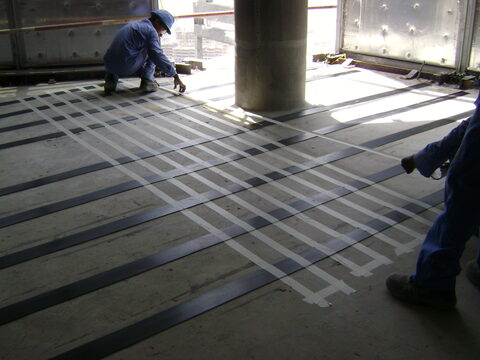
Match the material to the geometry. Plate (FidStrong FSL) is a pultruded, pre-cured laminate at about 65% fiber content and 1.6 g/cm³, bonded flat with a paste adhesive — the efficient choice for straight beam and slab soffits that need high one-directional force with few layers and consistent factory QC. Fabric (FidStrong FSC) is a dry weave saturated in place, so it conforms to corners and curves — the only option for shear U-wraps and column confinement.
| Property | CFRP plate (FSL) | CFRP fabric (FSC) |
|---|---|---|
| Form | Factory-pultruded laminate | Dry weave, site wet lay-up |
| Modulus | 165 GPa (laminate basis) | 240 GPa (net-fiber basis) |
| Tensile strength | 2,800–3,400 MPa (laminate) | 4,500 MPa (net fiber, Grade A) |
| Thickness | 1.2 / 1.4 / 3.0 mm | 0.11–0.33 mm per ply |
| Conforms to curves? | No — flat only | Yes — wraps corners (R ≥ 20 mm) |
| Field QC spec | Factory-set | ACI SPEC-440.12-22 (pull-off, witness panels) |
FSL / FSC values: FidStrong product data (ASTM D3039). Note the different test bases — see below.
Which is actually stronger?
It is the wrong question, because the two are tested on different bases. Fabric strength is reported on the net fiber area (Grade A: 4,500 MPa mean, 240 GPa), while plate strength is reported on the whole cured laminate (2,800–3,400 MPa, 165 GPa) — so the raw MPa are not comparable. ACI 440.2R states both bases yield the same force per unit width, and its own worked example concludes the correct basis for comparison is equal stiffness, not equal strength.
On that basis the numbers are concrete: an FSL14 plate strip provides about 231 MN/m of unit-width axial stiffness, while one ply of heavy FSC600A fabric provides about 78 MN/m — so it takes roughly three fabric plies to match one plate strip. That is why a flat, high-demand soffit is usually more efficient in plate: fewer layers, less labour, factory-consistent alignment.
When does plate win?
Plate wins wherever the surface is flat and the tension is one-directional — classic flexural strengthening of beam and slab soffits. Because a plate delivers high force in a single piece, it cuts the layer count on demanding jobs: the heaviest grade, FSL30 (3.0 mm), reaches about 8,100 kN/m characteristic capacity per unit width. Its fiber alignment and volume fraction are locked in at the factory by pultrusion, giving repeatable quality with no on-site wet-out. Plate is cut to length, bonded with a two-part thixotropic paste adhesive to a controlled 2–4 mm glue line, and rolled to squeeze-out.
When does fabric win?
Fabric wins wherever the geometry is not flat. Being flexible before cure, it wraps circumferentially around columns to confine the core — raising axial strength and ductility — and folds into three-sided U-wraps to add shear capacity, neither of which a rigid plate can do. Rectangular corners must be rounded to a radius of at least 20 mm before wrapping so the fiber is not kinked. Fabric also suits congested access and multi-directional demands, where thin plies can be layered in different orientations. See how to install carbon fiber fabric for the wet-lay-up method, and seismic retrofit with carbon fiber for confinement in practice.
Do they need different quality control?
Yes — and this is an asymmetry buyers often miss. Because fabric cures on site, it falls under the mandatory construction spec ACI SPEC-440.12-22, which requires pull-off testing (> 1.4 MPa / 200 psi, failing in the substrate) at least three times per 1,000 ft² per day, a fiber-orientation tolerance of ±5°, and witness-panel tensile testing every 5,000 ft². Plate is exempt: its 65% fiber volume and alignment are fixed by pultrusion at the factory, so those field tests do not apply. Both, however, demand a sound substrate — pull-off strength ≥ 1.4–1.5 MPa — and both are capped at a service temperature of Tg − 15 °C (Tg typically 60–82 °C).
Can you use both together?
Often, yes — and it is a recommended detail, not a compromise. A common design bonds a plate along the flexural tension face for capacity, then anchors its ends with fabric strips or U-wraps to control anchorage-zone debonding. An FDOT anchorage study ranks this “FRP strip/sheet” approach as its top recommendation — non-proprietary, least invasive, and the best-documented anchorage method it tested.
FAQ
Which is stronger, carbon fiber plate or fabric?
They are tested on different bases, so raw MPa is not a fair fight: FSC fabric reports 4,500 MPa / 240 GPa on a net-fiber basis, while FSL plate reports 2,800–3,400 MPa / 165 GPa on a cured-laminate basis. ACI 440.2R’s own example shows the correct comparison is equal stiffness, not strength — matching one plate strip took roughly three fabric plies.
Can carbon fiber fabric wrap a column?
Yes — that is its core confinement role. Flexible before cure, FSC fabric wraps circumferentially to confine the concrete core, raising axial strength and ductility (ACI 440.2R Ch. 12). Rigid FSL plate cannot conform to this geometry, and rectangular corners need rounding to a radius of at least 20 mm before wrapping.
Which is faster to install?
Plate has fewer field steps — cut to length, apply the paste adhesive, press and roll — with no on-site resin wet-out. Fabric requires priming, saturating each ply wet-on-wet, and passing ACI SPEC-440.12-22 field QC. No timed benchmark exists in the source data; this is a process comparison, not a stopwatch one.
Does fabric need more quality control than plate?
Yes. Because it cures on site, ACI SPEC-440.12-22 mandates pull-off testing (> 200 psi, substrate-mode failure) at least three times per 1,000 ft² per day, a ±5° fiber-orientation tolerance, and witness-panel tensile testing every 5,000 ft². Plate’s fiber volume and alignment are fixed at the factory, so none of these apply.
Is there one design code for both?
Yes. ACI 440.2R treats precured laminate and wet-lay-up fabric as two system types under one framework, using identical ψf factors (flexural 0.85; shear full-wrap 0.95, U-wrap 0.85) and identical carbon environmental factors (0.95 indoor, 0.85 outdoor). Fabric additionally falls under the separate mandatory construction spec, ACI SPEC-440.12-22.
Can plate and fabric be combined on one job?
Yes, and it is common: bond a plate along the flexural tension face, then anchor its ends with fabric strips or U-wraps to control anchorage-zone debonding. An FDOT anchorage study ranks this combined “FRP strip/sheet” method as its top recommendation for being non-proprietary and least invasive.
New to the topic? Start with what CFRP strengthening is, and see the role of the bonding resins in our structural epoxy adhesives guide.
FidStrong manufactures FSL carbon fiber plate and FSC carbon fiber fabric, tested to ASTM D3039, under ISO 9001, 14001, and 45001 quality systems, along with the matching plate adhesive and saturating epoxies. Design values here are drawn from ACI 440.2R and the product data sheets; confirm project-specific values against the governing code.