
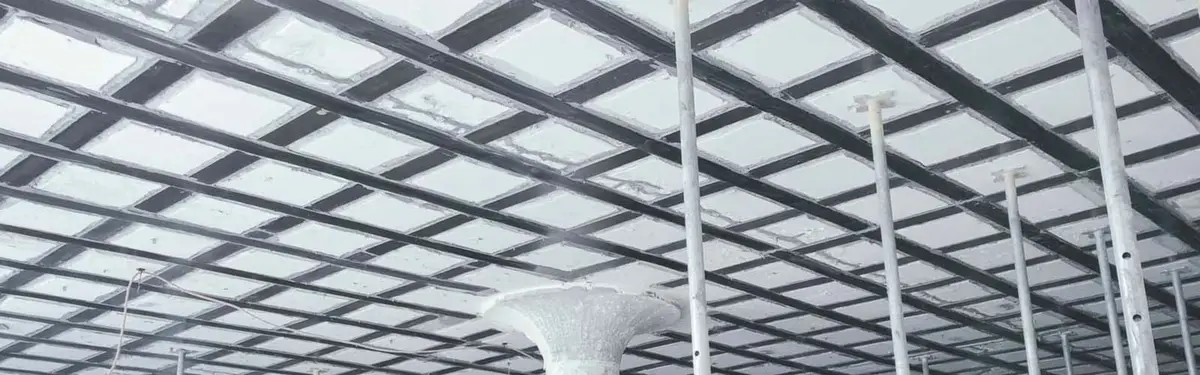
Carbon Fiber Plate for Beam & Slab Strengthening
Pultruded carbon fiber plates for flexural strengthening of beams, slabs, and walls.

Specifications at a glance
FSL is a pultruded carbon fibre plate for externally bonded flexural strengthening of concrete, timber and masonry. PAN-based unidirectional fibre at ≥ 65% by volume in a cured matrix, 165 GPa in every grade, supplied 1.2, 1.4 or 3.0 mm thick in 50, 80 and 100 mm widths. Because the plate is pre-cured, the laminate quality is set in the factory rather than by the weather on the day it is installed — the one structural difference between plate and wet lay-up fabric.
| Property | Value |
|---|---|
| Fibre Type | Carbon fibre, PAN-based, unidirectional |
| Fibre Content | ≥ 65% by volume (density 1.6 g/cm³) |
| Testing Standard | ASTM D3039 (≥ 25 specimens per property) |
| Design Standard | ACI 440.2R |
| Storage | Dry, no direct sunlight, −5°C to +35°C |
| Shelf Life | Unlimited in original, unopened packaging |
Mechanical Properties by Model
| Model | Thickness | Tensile Strength | Elastic Modulus | Elongation | Widths (mm) | Packaging |
|---|---|---|---|---|---|---|
| FSL12 | 1.2 mm | 2,900 MPa | 165 GPa | 1.8% | 50 / 80 / 100 | 100 m/roll |
| FSL12S | 1.2 mm | 3,400 MPa | 165 GPa | 2.1% | 50 / 80 / 100 | 100 m/roll |
| FSL14 | 1.4 mm | 2,900 MPa | 165 GPa | 1.8% | 50 / 80 / 100 | 100 m/roll |
| FSL14S | 1.4 mm | 3,300 MPa | 165 GPa | 2.0% | 50 / 80 / 100 | 100 m/roll |
| FSL30 | 3.0 mm | 2,800 MPa | 165 GPa | 1.7% | 50 / 100 | 50 m/roll |
Where It Is Used
Beam and slab soffits
The everyday case: flexural strengthening where load has increased, reinforcement has corroded, or an opening has cut a member.
Bridge girders and decks
Raising the capacity of an existing span without demolition, where closing the structure for a rebuild is not an option.
Industrial floors and machine bases
Slabs asked to take heavier plant than they were designed for, where the alternative is a new slab and the downtime that comes with it.
Correcting design and construction defects
Under-reinforced members, mis-placed bars, sections cut on site — a bonded plate restores capacity without changing the geometry much.
Timber and masonry
Beams and lintels in older buildings, where the plate is thin enough to disappear under a finish and light enough not to load the structure it is helping.
Where the finish must not change
1.2 mm of plate plus an adhesive line adds almost nothing to the depth, so headroom and appearance survive the strengthening.
Selection Guide
| Model | Thickness & grade | Choose it when |
|---|---|---|
| FSL12 | 1.2 mm · standard grade | The everyday plate for beam and slab soffits. Widths 50 / 80 / 100 mm, 100 m per roll. |
| FSL12S | 1.2 mm · high-strength grade | Same thickness and the same stiffness as FSL12, but about 14% more characteristic tensile strength. Take it when the design is strength-driven and you do not want to add thickness. |
| FSL14 | 1.4 mm · standard grade | About 17% more force and stiffness per millimetre of width than FSL12, for the same widths. The usual next step up. |
| FSL14S | 1.4 mm · high-strength grade | The highest force per width of the thin plates. Use it where anchorage length, not plate area, is the constraint. |
| FSL30 | 3.0 mm · heavy section | Two and a half times the stiffness per width of FSL12. Widths 50 and 100 mm only, 50 m per roll. A thick plate is harder to keep in contact on a bowed soffit, so check the substrate tolerance first. |
| Plate or fabric? | Pre-cured plate (FSL) | Wet lay-up fabric (FSC) |
|---|---|---|
| Where the quality is set | In the factory. The laminate arrives cured, so its properties do not depend on site mixing, roller work or the weather that day. | On site. Fibre content, wet-out and thickness are made by the installer, which is why fabric needs tighter supervision. |
| Geometry it suits | Flat surfaces carrying force in one direction — beam and slab soffits, mostly flexure. | Curved and irregular shapes, column wrapping, shear U-wraps — anywhere the reinforcement has to follow the member. |
| Substrate tolerance | Tighter. A stiff plate cannot follow a bowed soffit; unevenness has to be levelled first. | More forgiving — the fabric conforms, though the substrate still has to be sound and prepared. |
| Speed on site | Faster: prime, adhesive, press, done. No lay-up time, no wet-out to inspect. | Slower per square metre, but one roll covers shapes a plate cannot reach. |
All five grades share the same 165 GPa modulus, so switching grade changes the force the plate can carry, not the stiffness it adds. If deflection rather than strength is what you are fixing, go thicker or wider — the S grades will not help. Plates are bonded with FSE 362 plate adhesive over a primed, prepared substrate.
The strengthening design — how many plates, how wide, how long, and how the ends are anchored — belongs to the project engineer under ACI 440.2R, CNR-DT 200 or the local equivalent. Externally bonded FRP fails predominantly by debonding rather than by fibre rupture, so the plate’s tensile capacity is almost never what governs. Do not size a strengthening scheme from the table below alone.
Plate Capacity
Characteristic tensile force per plate
| Model | Thickness (mm) | 50 mm wide (kN) | 80 mm wide (kN) | 100 mm wide (kN) | Stiffness per m width (MN/m) |
|---|---|---|---|---|---|
| FSL12 | 1.2 | 168 | 269 | 336 | 198 |
| FSL12S | 1.2 | 192 | 307 | 384 | 198 |
| FSL14 | 1.4 | 196 | 314 | 392 | 231 |
| FSL14S | 1.4 | 217 | 347 | 434 | 231 |
| FSL30 | 3.0 | 405 | — | 810 | 495 |
Force = characteristic tensile strength × thickness × width, using the characteristic column of each TDS — not the mean. FSL30 is made in 50 and 100 mm widths only. These are material capacities, not design resistances: the strengthening design applies its own reduction factors on top.
Mean value against characteristic value
| Model | Mean tensile (MPa) | Characteristic (MPa) | Gap | Modulus (GPa) | Characteristic elongation (%) |
|---|---|---|---|---|---|
| FSL12 | 2900 | 2800 | 3% | 165 | 1.7 |
| FSL12S | 3400 | 3200 | 6% | 165 | 1.9 |
| FSL14 | 2900 | 2800 | 3% | 165 | 1.7 |
| FSL14S | 3300 | 3100 | 6% | 165 | 1.9 |
| FSL30 | 2800 | 2700 | 4% | 165 | 1.6 |
Characteristic = mean minus three standard deviations from at least 20 specimens tested to ASTM D3039, the basis ACI 440.2R §4.3.1 requires. Design uses the characteristic column. The dry-fibre figure some suppliers quote — 5800 MPa for this fibre — is a property of the bare filament and our own datasheet marks it “reference only, not for design”.
If a competitor’s plate looks dramatically stronger than these numbers, check three things before you believe it: whether the figure is a mean or a characteristic value, how many specimens it came from, and whether it is the laminate or the dry fibre. Those three questions account for most of the difference between datasheets that look nothing alike.
Bonding a Plate in Six Steps
Check the substrate first
Concrete has to be sound and the surface tensile strength adequate for the design — a pull-off test tells you, a visual inspection does not. Grind back laitance and unsound material to expose sound aggregate, and level any unevenness the stiff plate cannot follow.
Repair and level
Fill blowholes, honeycombing and chipped areas, and inject dormant cracks before bonding rather than after. A plate bridging a void has no bond there, and that is where debonding starts.
Prime
Apply primer to the prepared, dry substrate and let it reach the tack state the TDS specifies. Priming is what stops the adhesive being drawn into the concrete pores and starving the bond line.
Butter the plate and the substrate
Wipe the bond face of the plate clean, then apply FSE 362 plate adhesive to both plate and substrate, crowned in the middle so air is pushed outwards rather than trapped when the plate goes on.
Press until adhesive comes out both sides
Press the plate home with a rubber roller working from the centre out. Adhesive squeezing out along both edges is the sign the bond line is full — strike it off before it sets. Working time falls sharply as temperature rises; check the adhesive TDS for the day you are actually working.
Cure undisturbed, then check
Leave the plate supported and undisturbed for the adhesive’s full cure. Then tap-test the bonded area for hollow sound and record it — debonding is the dominant failure mode for externally bonded FRP, so this check is the one that matters.
Frequently Asked Questions
Plate or fabric — which should I use?
Plate for flat surfaces carrying force in one direction, mostly beam and slab soffits in flexure. Fabric for curved or irregular shapes, column wrapping and shear U-wraps. The structural difference is where the laminate quality is decided: a plate arrives cured from the factory, while a fabric laminate is made on site by the installer and depends on their wet-out and the conditions that day.
Why do the S grades not add stiffness?
Because every FSL grade has the same 165 GPa modulus — the S grades raise strength, not stiffness. Stiffness per width comes from thickness: 198 MN/m at 1.2 mm, 231 at 1.4 mm, 495 at 3.0 mm. If you are strengthening against deflection rather than against failure, thickness or width is the lever, and the grade is not.
Which tensile number should I design with?
The characteristic one. Characteristic equals the mean minus three standard deviations from at least 20 specimens (ASTM D3039), the basis ACI 440.2R §4.3.1 requires. Both columns are on our datasheets so you can see the gap, which runs 3–6% here. Be careful with any datasheet quoting a dry-fibre figure such as 5800 MPa — that is the bare filament, not the laminate, and it is not a design value.
What actually fails first?
The bond, almost always — externally bonded FRP is governed by debonding rather than by fibre rupture, which is why the plate’s own tensile capacity is rarely the controlling number. That is also why substrate preparation, end anchorage and the pull-off test matter more than the headline strength of the plate.
Can it be used outdoors or in a marine environment?
Yes, with the environmental reduction factor the design code applies to carbon — and carbon is the least penalised of the FRP fibres for exposure. The plate itself does not corrode. Protect it from prolonged UV, and remember the epoxy adhesive, not the carbon, sets the service temperature limit.
How is it fixed — do I need anchors?
It is bonded with FSE 362 plate adhesive over a primed substrate; the adhesive carries the shear into the concrete. Whether the ends also need mechanical anchorage is a design decision, and it depends on the anchorage length available and the stress at the plate end — not something to decide on site.
Do you have a European Technical Assessment or ICC-ES report for the plate?
No. FSL plates ship against their own technical data sheets, with mean and characteristic values from ASTM D3039 testing on the stated specimen basis, plus a Mill Test Certificate and Certificate of Analysis for the batch. If your specification requires a particular third-party approval, tell us at enquiry stage and we will say plainly whether we can meet it.
Documents & Downloads
One TDS per grade
FSL12, FSL12S, FSL14, FSL14S and FSL30 each have their own datasheet with mean and characteristic columns and the specimen basis footnoted.
MTC + COA with every shipment
Every batch ships with a Mill Test Certificate and a Certificate of Analysis.
Request a Quote
Send the member, the span, what the load is going to and whether an engineer has already sized the plates — we come back within one working day with the grade, the widths, the metres and the adhesive quantity. If the design is not done yet, say so and we will tell you what the engineer will need from us.


