
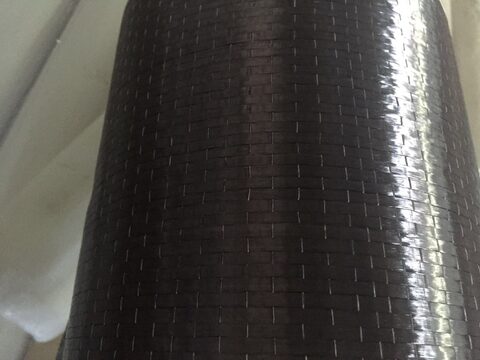
At a glance
- Seismic retrofit is about ductility, not just strength: a CFRP wrap converts brittle failure into ductile behaviour so a column can dissipate earthquake energy instead of shattering.
- Confinement is the core move: a hoop wrap raises confined strength and, crucially, extends ultimate strain from ~0.003 to as much as 0.01 (ACI 440.2R Ch. 12).
- It adds almost no seismic mass: carbon is ~1.5–1.6 g/cm³ versus steel’s 7.9, and inertial force scales with mass — unlike steel jacketing or section enlargement.
Carbon fiber seismically retrofits a concrete structure by making its members ductile — wrapping columns to confine the concrete, clamping weak lap splices, and adding shear capacity — all without adding the mass that would raise the earthquake force itself. This guide explains the mechanism and the numbers behind it, traced to ACI 440.2R. For the basics, see what CFRP strengthening is.
Why is seismic retrofit about ductility, not just strength?
Earthquakes don’t just push harder — they cycle a structure back and forth into its inelastic range, and a member that fails brittly (shear, splice slip, crushing) collapses with no warning. ACI 440.2R Chapter 13, working within ASCE/SEI 41 evaluation, follows capacity design: convert brittle mechanisms into ductile ones so the structure can absorb and dissipate energy. That is why the goal of a CFRP wrap is usually more deformation capacity, not simply more force.
How does a CFRP wrap confine a column?
A circumferential wrap restrains the concrete’s outward (Poisson) expansion under axial load, putting the core into triaxial compression. That raises both the confined strength f′cc (ACI 440.2R Eq. 12.1) and, more importantly, the ultimate strain — the confined strain is capped at εccu ≤ 0.01, over three times the 0.003 assumed for unconfined concrete. The fiber only mobilizes about 55% of its rupture strain in this mode (strain-efficiency factor κε ≈ 0.55, calibrated on 251 tests), and a wrap must deliver a minimum confinement ratio of fℓ/f′c ≥ 0.08 to actually remove the brittle descending branch. The confinement strength-reduction factor is ψf = 0.95. Fabric — not rigid plate — is used here because it wraps the curve.
Does a square column confine as well as a round one?
No. A circular section is maximally efficient (shape factors κa = κb = 1.0) because the whole core is confined. A rectangular section only confines the concrete inside parabolic arcs spanning its rounded corners, so its effectiveness is geometry-penalized: κa = (Ae/Ac)(b/h)². Seismic wraps are held to tighter limits than static confinement — aspect ratio h/b ≤ 1.5 and a maximum section dimension of 900 mm — and every square corner must be rounded to a radius of at least 20 mm to cut the stress concentration. Beyond those limits, the section must be reshaped or supplemented with FRP anchors.
What else can carbon fiber fix in a seismic retrofit?
Confinement is the headline, but three other mechanisms matter. A circumferential jacket clamps a deficient lap splice (ACI 440.2R Sec. 13.3.3), applying lateral pressure that stops the bars slipping apart — a worked ACI example needs about 2 mm of jacket on a 457 mm column. A minimum FRP ratio also restrains longitudinal bar buckling inside the plastic hinge (Sec. 13.3.4). For shear in stress-reversal zones, a full circumferential wrap is required, with effective strain capped at 0.004 to preserve aggregate interlock. And at beam-column joints, FRP is applied in both directions with anchorage proven by testing, since unanchored joint reinforcement is treated as ineffective. The saturating resin for all of these is FSE322 over FSC carbon fabric; sizing the layers is covered in calculating carbon fiber layers for column confinement.
Why does carbon fiber add no seismic mass?
Because seismic force is inertial: F = m·a, so anything that adds mass adds earthquake demand. Carbon fiber is 1.5–1.6 g/cm³ against steel’s 7.9 g/cm³ (ACI 440.2R Table 4.2.1), and a jacket is only a few millimetres thick, so it adds negligible weight. Steel jacketing or section enlargement add both stiffness and mass — raising the very force the structure must resist — which is a decisive advantage for CFRP in retrofit.
FAQ
Does adding a CFRP wrap increase the seismic weight of a column?
No. Carbon fiber is 1.5–1.6 g/cm³ versus about 7.9 g/cm³ for steel (ACI 440.2R Table 4.2.1), and wraps are only a few millimetres thick. Since seismic inertial force scales with mass, a carbon jacket adds negligible weight compared to steel jacketing or enlarging the column section.
Why does confinement matter in an earthquake and not just under static load?
A hoop wrap restrains the concrete’s lateral expansion under compression, raising peak strength f′cc and ultimate strain εccu (ACI 440.2R Eq. 12.1). The strain gain matters most — it lets the plastic hinge rotate and dissipate energy through repeated load cycles instead of crushing suddenly.
Is a square column as effective to confine as a round one?
No. Circular sections get full shape efficiency (κa = κb = 1.0). Rectangular sections only confine the area inside parabolic arcs between rounded corners, so confinement is weaker — which is why seismic wraps cap the non-circular aspect ratio at h/b ≤ 1.5 and require corner rounding to R ≥ 20 mm.
How does an FRP wrap fix a short or inadequate lap splice?
A circumferential jacket clamps the splice zone, applying lateral pressure that resists the bars slipping apart under cyclic load (ACI 440.2R Sec. 13.3.3). Required jacket thickness follows Eq. 13.3.3a, and splice-bar stress is capped per Eq. 13.3.3b, calibrated against Harries et al. (2006) test data.
What can’t CFRP fix in a seismic retrofit?
It can’t correct structural irregularity in stiffness or strength distribution, and it can’t survive fire unprotected — the epoxy must stay below Tg − 15 °C (Tg typically 60–82 °C). It’s a local ductility fix, and still requires code-qualified engineering design.
Does CFRP confinement replace the structure’s original strength?
No. ACI 440.2R’s design philosophy requires the un-strengthened structure to still resist a minimum load — 1.1× dead load + 0.75× live load — even if the FRP were lost. The FRP only carries the added seismic demand; it never substitutes for the original load path.
Related reading: the durability of CFRP strengthening covers how the resin ages, which bounds where an exposed seismic wrap can be used.
FidStrong manufactures FSC carbon fiber fabric and the FSE saturating epoxies used for seismic wraps, under ISO 9001, 14001, and 45001 quality systems. Design values here are drawn from ACI 440.2R; seismic retrofit is licensed-engineer work under ASCE/SEI 41 and the governing code — confirm all values against the project design.