
At a glance
- Structural carbon fiber is PAN-based — drawn, oxidised, then carbonised. Grades are defined by tested strength and modulus (ASTM D3039), not by a tow brand label.
- Higher modulus costs strength and ductility. Representative code values: a low-modulus system ~160 GPa / 2,800 MPa / 1.6% strain versus a high-modulus one ~300 GPa / 1,500 MPa / 0.5%.
- A heavier fabric is not a stronger fibre. Areal weight (200→600 g/m²) scales cured ply thickness (0.111→0.333 mm), not the fibre’s grade.
- Industry labels vs tested grades. “T300/T700” and “3K/12K” describe the raw fibre; FidStrong grades fabric A / B / C by tested values — Grade A 4,500 MPa mean / 4,000 MPa characteristic at 240 GPa; B and C 3,800 / 3,500 MPa mean at 230 GPa (ASTM D3039).
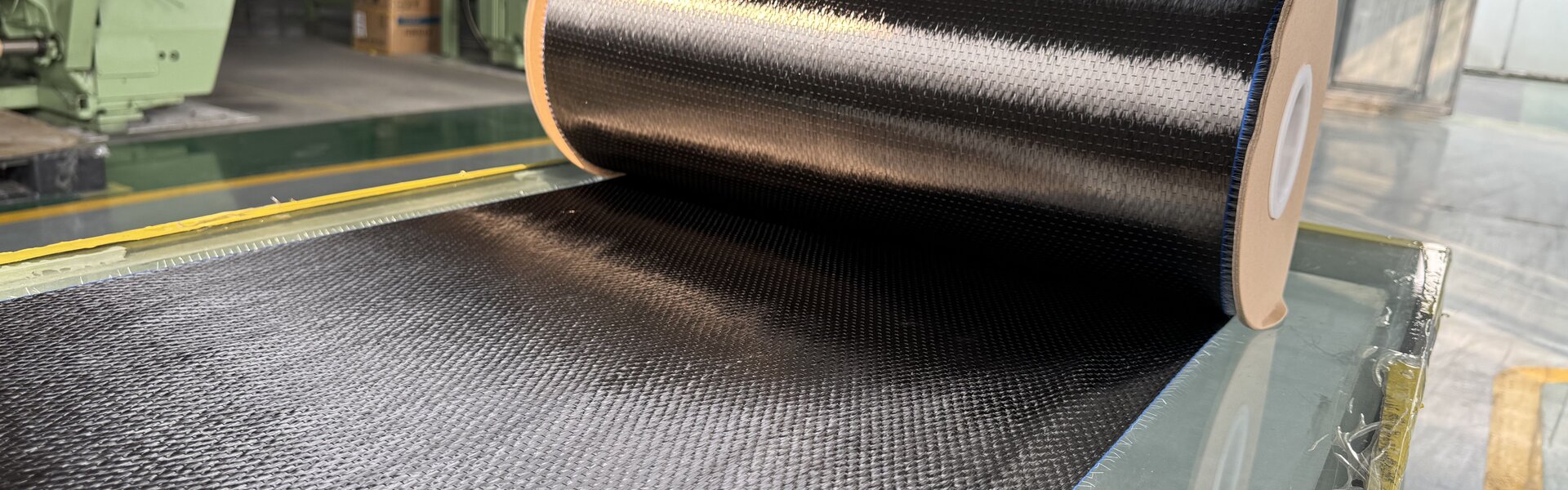
Carbon fibre for structural strengthening is graded by measured mechanical performance — strength, modulus, and strain — not by a raw-material tow label, and the number that governs a design is rarely the fibre’s headline strength anyway. This guide explains what carbon fibre is made from, how it is actually classified, and how grade choice affects a strengthening design, grounded in FidStrong data sheets and design codes. To turn these numbers into a spec, see how to read a CFRP technical data sheet.
What is carbon fibre made from?
Almost all structural carbon fibre — and every FidStrong carbon product — is PAN-based: a polyacrylonitrile precursor is drawn into filaments, oxidised (stabilised), then carbonised at high temperature into a nearly pure-carbon fibre with highly axially-oriented graphitic microcrystallites. A second route, pitch-based precursor, exists in the wider industry for ultra-high-modulus fibre, but it is a niche outside strengthening work. The general material envelope for carbon fibre spans a wide range — modulus roughly 200–800 GPa and strength 2,500–6,000 MPa (ACI 440R-07) — but structural strengthening uses only the lower-modulus, higher-strength end of it.
What do 3K / 12K tow and T300 / T700 labels actually mean?
They describe the raw fibre, not the composite you design with. “3K / 12K / 24K” is the tow count — thousands of continuous filaments bundled in one tow; a larger tow is cheaper per kilogram and is what heavier fabrics are usually woven from, but the tow count says nothing about strength. “T300 / T700 / T800” and “M40 / M55” are one fibre producer’s product-family names for its high-strength (T) and high-modulus (M) lines; other producers use different names for comparable fibre. FidStrong data sheets state the precursor (PAN) and the strength, modulus and elongation of the finished fabric tested under ASTM D3039 rather than a producer’s tow label, because the label cannot be verified on the roll and is not what a strengthening design uses.
How is carbon fibre classified — and why not by a “T-number”?
By tested performance. A credible grade is defined by its measured tensile strength, modulus, and elongation under ASTM D3039, not by a precursor tow-brand designation. FidStrong grades its carbon fiber fabric by strength class — Grade A (high-strength), B (medium), C (economy) — each with published, tested values; a raw-material tow label tells you nothing verifiable about the finished composite. A supplier who leads with a tow-brand grade instead of a tested strength-and-modulus pair with a method behind it is selling the fibre, not the strengthening system.
High-strength vs. high-modulus — what’s the trade?
They pull against each other. Representative code values (CNR-DT 200 R1/2013, Table 2-1) show a low-modulus system at 160 GPa / 2,800 MPa / 1.6% rupture strain and a high-modulus system at 300 GPa / 1,500 MPa / 0.5% — roughly doubling the modulus nearly halves the strength and cuts the strain to failure about threefold. Higher modulus buys stiffness (less deflection, more load shared before the steel yields); it does not buy strength. Most strengthening fabric sits in a standard-modulus band, and draft Eurocode Annex J only qualifies systems with 150 GPa ≤ Ef ≤ 230 GPa in the first place.
| System (representative) | Modulus | Tensile strength | Rupture strain |
|---|---|---|---|
| Low-modulus | 160 GPa | 2,800 MPa | 1.6% |
| High-modulus | 300 GPa | 1,500 MPa | 0.5% |
| FidStrong Grade A fabric | 240 GPa | 4,500 MPa mean / 4,000 MPa characteristic | 1.8% |
| FidStrong Grade B/C fabric | 230 GPa | 3,500–3,800 MPa mean / 3,200–3,400 MPa characteristic | 1.7% |
Does a heavier fabric mean a stronger fibre?
No — a common misconception. Within one grade, areal weight (g/m²) scales the cured ply thickness and the force a ply can carry, not the fibre’s intrinsic strength class: FSC200 (200 g/m²) cures to 0.111 mm, FSC300 to 0.167 mm, FSC600 to 0.333 mm. A 300 g/m² Grade A fabric has the same 240 GPa modulus and 4,500 MPa mean strength as a 200 g/m² Grade A — only the thickness and total per-metre capacity differ. Choose weight for the capacity you need per ply; choose grade for the strength and stiffness class.
Why does the same fabric show two very different strengths?
Because there are two legitimate cross-section bases, and the difference is dramatic. On a net-fibre-area basis, FSC200A reads 4,500 MPa at 240 GPa; on a gross cured-laminate basis (fibre diluted into the full resin-saturated thickness) the same fabric reads about 1,248 MPa at 66.6 GPa — a ~3.6× drop for identical material. Never mix bases in one calculation, and never design to a dry-fibre reference number: FidStrong’s plate data sheet states outright that its 5,800 MPa dry-fibre value is reference-only and must not be used for design (the design value is the 2,800–3,400 MPa laminate figure).
Does the grade even govern the design?
Often it does not. In flexural strengthening the usable strain is capped by debonding — εfe = min(εfd, 0.9εfu), with εfd = 0.41√(f′c/(n·Ef·tf)) (ACI 440.2R Eq. 10.1.1) — so the bond gives out before the fibre reaches its rated strength; in confinement, only about 55% of rupture strain is credited (Kε ≈ 0.55). Note that a higher-modulus fibre sits in the denominator of εfd, so a stiffer grade actually reaches its debonding-limited strain sooner. Grade choice changes where the design gets capped — and how much stiffness you add — more than it raises the raw usable strength. See load-transfer mechanics for why.
FAQ
Does a higher tow-brand number mean a stronger fibre?
It is not a design property. Tow-brand grades are raw-material marketing labels; FidStrong grades carbon by measured tensile strength, modulus, and elongation per ASTM D3039, never by a brand designation. Design from the tested mean and characteristic values on the data sheet, not from a tow label.
What is the difference between high-strength and high-modulus carbon fibre?
They trade off. Representative values show a low-modulus system at ~160 GPa / 2,800 MPa / 1.6% strain versus a high-modulus one at ~300 GPa / 1,500 MPa / 0.5%. Higher modulus adds stiffness (less deflection) but reduces strength and ductility; most strengthening fabric is standard-modulus, high-strength.
Is a heavier (600 g/m²) fabric a higher grade than a 200 g/m² one?
No. Within a grade, areal weight scales cured ply thickness (200→0.111 mm, 600→0.333 mm) and per-metre capacity, not the fibre’s modulus or strength class. A 300 g/m² Grade A has the same 240 GPa / 4,500 MPa as a 200 g/m² Grade A.
Why does one fabric list both ~4,500 MPa and ~1,250 MPa?
Two cross-section bases, not two materials. 4,500 MPa is a net-fibre-area basis (bare reinforcing fibre); ~1,248 MPa is a gross cured-laminate basis (fibre diluted into the full resin thickness). Confirm which basis a number uses and never mix them in one calculation.
Can I design with the 5,800 MPa dry-fibre number?
No. Dry-fibre values are reference-only — FidStrong’s own plate data sheet bars using 5,800 MPa for design and directs you to the pre-cured laminate values (2,800–3,400 MPa). Even those are usually capped further by debonding once the system is bonded to concrete.
Does choosing a higher grade give me proportionally more capacity?
Rarely. Flexural design strain is capped by debonding, and confinement credits only ~55% of rupture strain, so raw fibre strength is seldom fully used. A higher-modulus grade adds stiffness but reaches its debonding-limited strain sooner — grade choice shifts where the cap lands more than it lifts the usable strength.
How much does carbon fibre weigh, and why does that matter for strengthening?
Carbon fibre has a density of about 1.7–2.2 g/cm³ (ACI 440R-07); FidStrong’s cured CFRP plate and rebar are 1.6 g/cm³ (TDS) — roughly one-fifth the density of steel. For strengthening this means the dead load added by a CFRP layer is negligible, so capacity is added with practically no increase in the member’s self-weight.
FidStrong manufactures PAN-based carbon fabric, plate, mesh, and rebar, each graded by tested performance (ASTM D3039) under ISO 9001, 14001, and 45001 systems. Property ranges here are from FidStrong data sheets and design codes (ACI 440.2R, CNR-DT 200, Eurocode); confirm design values and basis against the data sheet and a qualified engineer.