
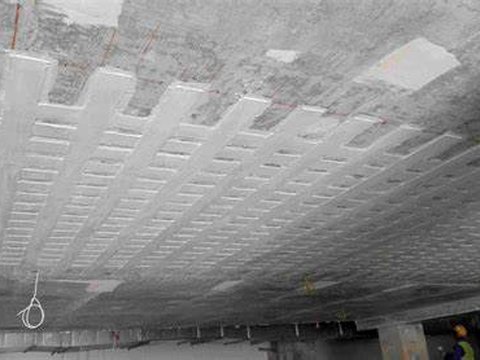
At a glance
- Carbon is the most durable FRP: its environmental reduction factor stays 0.85–0.95 (vs glass 0.50–0.75), and it can sustain ~0.90 of its strength over 50 years versus ~0.30 for glass.
- Three limits bound it: a mandatory UV topcoat, a service temperature 15 °C below the resin’s glass-transition point (Tg 60–82 °C), and no reliance in a fire.
- By design, the structure survives without it: ACI requires the unstrengthened member to still carry 1.1× dead + 0.75× live load if the FRP were lost.
A properly designed, protected CFRP strengthening system is engineered for decades of service — and carbon is the most durable of the FRP fibers by a wide margin. This guide covers how CFRP ages under environment, load, heat, and UV, and how design accounts for each, traced to ACI 440.2R — the systems in question being FidStrong FSC carbon fabric and FSL plate. For the fundamentals, see what CFRP strengthening is.
How durable is CFRP, really?
Two codified numbers answer it. First, the environmental reduction factor CE (ACI 440.2R Table 9.4), applied directly to the fiber’s strength: carbon is 0.95 indoors, 0.85 outdoors, and still 0.85 in aggressive chemical or wastewater exposure — glass drops to 0.65 and then 0.50. Second, the 50-year creep-rupture stress ratio (§4.4.1): carbon can sustain about 0.90 of its short-term ultimate strength for 50 years, against roughly 0.30 for glass. ACI 440.2R states plainly that carbon has the best creep-rupture resistance and is the least fatigue-sensitive of the FRP fibers.
Why does carbon outlast glass?
Chemistry. Bare carbon fiber is inert to both alkaline and acidic environments, while bare glass fiber degrades in the alkaline pore water of concrete (ACI 440.2R §9.3) — which is why high-moisture, high-alkalinity service defaults to carbon. The factor table captures it in one striking asymmetry: moving carbon from ordinary outdoor exposure to an aggressive chemical environment costs it nothing further (0.85 to 0.85), whereas glass takes a real additional penalty (0.65 to 0.50). Glass rebar faces a related but numerically distinct alkaline-durability tradeoff internally — see GFRP rebar vs. steel rebar.
How does design account for long-term stress?
With a deliberate margin. Even though carbon can sustain about 0.90 of its strength over 50 years, ACI 440.2R caps the design sustained-plus-cyclic stress at 0.55 ffu for CFRP (Table 10.2.9) — a single limit that covers both creep and fatigue, set well below the material’s actual long-term capacity. Glass is capped far lower at 0.20. That gap between what carbon can do (0.90) and what design allows (0.55) is the built-in safety buffer against decades of sustained and cyclic load, including the cyclic demand of a seismic retrofit.
What are the environmental limits — UV, heat, and fire?
Three that govern where CFRP can be exposed. UV: cured epoxy CFRP must never be left exposed — the last wet layer is broadcast with 0.5–1.0 mm of quartz sand plus a compatible topcoat (inorganic FRCM systems need none). Heat: service temperature must stay at least 15 °C below the epoxy’s glass-transition temperature, and with Tg typically 60–82 °C that puts the ceiling around 45–67 °C; in humid service the lower wet-Tg applies. Fire: ACI 440.2R conservatively assumes the FRP contribution is lost entirely unless proven otherwise, so exposed strengthening in fire-rated applications needs passive protection — see fire protection strategies.
What if the CFRP fails — does the structure collapse?
No, and this is deliberate. ACI 440.2R’s core safety principle (Eq. 9.2) requires the original, unstrengthened structure to independently carry 1.1× dead load plus 0.75× live load even with zero contribution from the FRP. The strengthening adds capacity for the new demand; it is never permitted to be the sole thing holding the structure up. Combined with carbon’s inherent durability and the conservative design caps above, that is what makes CFRP a genuinely long-term solution rather than a patch.
FAQ
How long does CFRP strengthening last?
ACI 440.2R doesn’t give a flat “years” figure; it states a 50-year creep-rupture stress ratio of about 0.90 for carbon (versus 0.30 for glass) and applies an environmental reduction factor of 0.85–0.95 for carbon. Together, a properly designed, UV-protected CFRP system is engineered for multi-decade sustained-load service.
Does CFRP strengthening need maintenance?
Mainly two items: keep the UV topcoat intact — cured epoxy CFRP must never be left exposed — and periodically inspect the bond, since debonding, not fiber rupture, is the typical long-term failure mode. The substrate bond must exceed 1.4 MPa with cohesive failure inside the concrete.
Is glass fiber as durable as carbon for strengthening?
No. Per ACI 440.2R Table 9.4, glass’s environmental factor is far lower (0.50–0.75 vs carbon’s 0.85–0.95), and its 50-year creep-rupture ratio is only ~0.30 vs carbon’s ~0.90 — because bare glass degrades in alkaline pore water while carbon is chemically inert to both acids and alkalis.
What happens to CFRP strengthening in a fire?
ACI 440.2R conservatively assumes the FRP contribution is entirely lost in a fire (§9.2.1) unless tested otherwise — the underlying structure must survive a reduced load combination without any help from the FRP. Exposed CFRP in fire-rated applications therefore needs passive fire protection.
Can CFRP be used in hot environments?
Only up to the epoxy’s glass-transition temperature minus a 15 °C margin (ACI 440.2R §1.2.1.3). Typical room-temperature-cured systems have a Tg of 60–82 °C, so the service ceiling is roughly 45–67 °C; above that the resin softens and bond strength drops. Check the specific adhesive’s tested Tg, not a generic range.
If the CFRP debonded, would the structure collapse?
No, by design. ACI 440.2R (Eq. 9.2) requires the original unstrengthened structure to carry 1.1× dead plus 0.75× live load even with zero contribution from the FRP. The strengthening adds capacity; it is never allowed to be the sole thing preventing collapse.
FidStrong manufactures FSC carbon fabric and FSL carbon plate, tested to ASTM D3039, under ISO 9001, 14001, and 45001 quality systems. Durability values here are drawn from ACI 440.2R (Table 9.4, §4.4.1, Table 10.2.9, §9.2); confirm project-specific values against the governing code and product data sheet.