
At a glance
- Anchorage fixes debonding — the dominant failure of externally bonded CFRP (a 375-beam database debonded 100%, 70% at cracks, 30% at ends) — by holding the laminate where bond alone would peel.
- Not every job needs it: three-sided U-wraps must be anchored to develop full strain; fully-wrapped sections and low-demand ends often don’t.
- Best type: an FDOT study ranks the FRP strip/sheet anchor first — non-proprietary, least invasive — and ACI cites 20–60% shear gains from anchored U-wrap terminations.
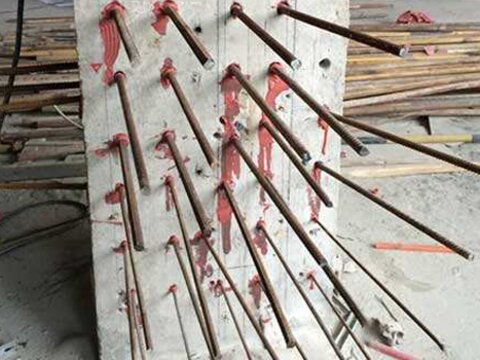
Mechanical anchorage lets a bonded CFRP laminate develop more of its strength by stopping it from peeling off before the fiber does its work. Since debonding usually governs a strengthening design, anchorage is often what turns a bond-limited detail into a fully effective one. This guide covers when it’s required, the options, and how much it adds — grounded in ACI 440.2R and an FDOT anchorage study.
Why does externally bonded CFRP need anchorage?
Because it peels before it breaks. In a database of 375 externally bonded FRP flexural beams with no anchorage, 100% failed by debonding — 70% by intermediate-crack debonding starting at flexural cracks, 30% at the plate ends — and essentially none reached fiber rupture. Debonding can run through the adhesive, the interface, or the concrete cover, but most often it tracks along the concrete surface because concrete is weakest in tension. Anchorage intervenes exactly at those two initiation points.
When is anchorage actually required?
Not on every job — it addresses a specific risk. The clearest rule: a three-sided U-wrap must be anchored to be designed at the effective strain of a full wrap, because its two cut edges are the highest-probability debonding starters. In shear, an unanchored U-wrap or side-bonded system is bond-length-limited (effective strain εfe = κv·εfu, capped at 0.004), and it already carries a lower strength-reduction factor (ψf = 0.85 for U-wrap/two-sided vs 0.95 for a full wrap). Where that bond-limited strain can’t meet demand, you anchor. Fully-wrapped sections and low-demand end zones frequently need nothing.
What anchorage types exist, and which is best?
An FDOT report (BEA90) catalogued seven: FRP spike/tow anchors, U-wraps, grooved U-anchors, staple anchors, FRP strip/sheet anchors, mechanical metallic anchors, and longitudinal chases. Scored on practicality — proprietary status, invasiveness, install tolerance, complexity, and design-guide completeness — the FRP strip/sheet anchor ranked first: non-proprietary, the least invasive (1 of 5), and backed by full ACI/fib/FDOT design guidance. The fiber spike anchor ranked third, and mechanical metallic anchors fourth (reserved for cases needing forced confinement where bonded strips underperform).
How much strength does anchorage add?
It depends on the system, and the honest answer is that studies shouldn’t be cross-compared loosely. ACI PRC-440.2-23, which for the first time formalizes fiber-anchor design (§14.1.4), cites a 20–60% shear-strength increase from properly anchored U-wrap terminations, with rules of anchor spacing ≤ 250 mm and a fan angle ≤ 60°. But direction can matter more than anchor count: in full-scale girder tests, vertical strips with spike anchors alone lifted ultimate shear by just ~2%, while adding horizontal strips took it to ~36% — the transverse strip, not the spike, was the decisive contributor.
Why can’t you just extend the bonded length?
Because bond force has a ceiling. There is an effective bond length beyond which additional bonded length transfers essentially no more force — the anchorable force asymptotes. This is captured historically by the Holzenkämpfer model (fib Bulletin 14) and its modern effective-bond-length descendants. So “just bond it further” doesn’t develop more capacity past that length; only a mechanical or fiber anchor extends the achievable strain. The installation detailing of the anchor is what makes it work.
What about NSM and FidStrong’s anchor products?
Near-surface-mounted (NSM) strips, set in a groove with epoxy on three sides, are better confined, so ACI allows a higher debonding cap of εfd = 0.7εfu instead of the surface-bonded formula — effectively built-in anchorage. For discrete anchors, FidStrong’s FX50 carbon rope is field-saturated with FSE322 epoxy, fanned onto the fabric and embedded in a drilled hole; it is part of the anchoring system range.
FAQ
Do I need mechanical anchorage on every CFRP job?
No. Anchorage addresses a specific debonding risk, not a default requirement. It’s required for three-sided U-wraps (to use full-wrap-equivalent strain) and wherever bond-limited strain (κv·εfu ≤ 0.004) can’t meet demand. Fully-wrapped sections and low-demand end zones often don’t need it.
What’s the best anchorage type to specify?
FDOT’s study ranks FRP strip/sheet anchors first — non-proprietary, lowest invasiveness (1 of 5), and complete ACI/fib/FDOT design guidance. Fiber spike anchors rank third; mechanical metallic anchors fourth, reserved for cases needing forced confinement where bonded strips underperform.
How much strength does anchorage actually add?
It’s system-specific. ACI 440.2R §14.1.4 fiber anchors on U-wrap terminations add 20–60% shear strength. But girder tests showed strip direction mattered more than spike-anchor count — vertical strips alone added ~2%, while adding horizontal strips reached ~36%.
Can I just extend the bonded length instead of anchoring?
No. Effective bond length is a hard ceiling — past it, added bonded length transfers no more force. Only a mechanical or fiber anchor extends the achievable strain beyond what bond length alone permits.
Why does NSM need less anchorage than surface-bonded CFRP?
NSM strips sit in a groove confined on three sides by concrete and epoxy, so ACI 440.2R allows a debonding cap of εfd = 0.7εfu — well above the surface-bonded formula. Less exposed bonded surface means less area available to debond from.
An anchor rope lists 5,500 MPa — can I design to that?
No, that’s the dry-fiber reference. Once saturated and bundled, FidStrong’s FX50 anchor design-basis strength is 2,400 MPa (210 GPa, 0.9% elongation) per its data sheet. Always design anchors on saturated-bundle values, never dry-fiber numbers — the same caution applies across the industry.
Anchorage is most decisive in seismic retrofits, where cut-edge U-wraps carry cyclic shear. For the basics, see what CFRP strengthening is.
FidStrong manufactures FSC carbon fabric, FSE saturating epoxies, and FX50/FCA carbon anchors, under ISO 9001, 14001, and 45001 quality systems. Design figures here are drawn from ACI 440.2R (§14.1.4, Table 11.3), fib Bulletin 14, an FDOT anchorage study, and the product data sheets; anchorage is engineered work — confirm all values against the governing code.