
At a glance
- One choice drives everything: FRCM embeds an open fiber mesh in inorganic cement mortar; CFRP fabric saturates fiber in epoxy. That matrix decides fire, breathability, damp tolerance, and strength use.
- FRCM for the hard substrates: masonry, damp, heritage, or fire-rated work — no Tg ceiling, breathable, no UV topcoat.
- CFRP fabric for maximum strength in a thin, sealed, epoxy-bonded laminate on sound, dry concrete.
Choose FRCM when the job is masonry, damp, historic, or fire-rated, and epoxy-bonded CFRP fabric when you need maximum strength in a thin profile on sound, dry concrete. Both put high-strength fiber on a structure, but one binds it in cement mortar and the other in epoxy — and that single difference cascades into every practical trade-off below. Figures are traced to ACI 549, ACI 440.2R, and the product data sheets. New here? See what CFRP strengthening is.
What is the core difference between FRCM and CFRP fabric?
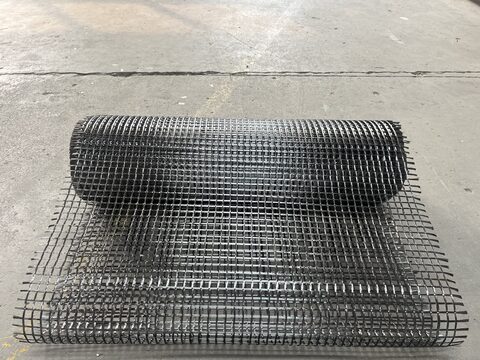
The matrix. FRCM (fiber-reinforced cementitious matrix) presses an open fiber mesh into an inorganic cement mortar, relying on mechanical interlock through the mesh openings. CFRP fabric wet-lays carbon fiber in an organic epoxy resin that fully impregnates and chemically bonds it. Everything else — how each behaves in fire, whether it breathes, whether it tolerates damp, how much fiber strength it actually uses — follows from that one choice.
| Property | CFRP fabric (epoxy) | FRCM (cement mortar) |
|---|---|---|
| Matrix | Organic epoxy resin | Inorganic cement mortar |
| Fire / heat | Limited by Tg (60–82 °C) | No Tg ceiling, fire-resistant |
| Breathability | Sealed surface | Vapor-permeable |
| Damp substrate | Needs moisture < 4% | Tolerates damp (SSD) |
| UV outdoors | Topcoat mandatory | None needed |
| Bond | Chemical, full impregnation | Mechanical interlock |
Which survives fire and heat?
FRCM, decisively. Epoxy-bonded CFRP is capped by its resin’s glass transition temperature (Tg typically 60–82 °C, ACI 440.2R), and service temperature must stay at least 15 °C below it — near Tg the resin softens and bond drops, and without fireproofing the strengthening effect is lost quickly in a fire. FRCM’s inorganic mortar has no Tg ceiling and is inherently fire-resistant; its PBO fiber does not decompose until about 650 °C. Where a fire rating rules out epoxy, FRCM is the standard answer — see fire protection strategies for CFRP.
Which works on damp or historic masonry?
FRCM again. Its cement matrix tolerates a damp substrate — the carbon-mesh system only needs a saturated-surface-dry surface — while epoxy CFRP demands a substrate moisture content below 4% (ASTM D4263). FRCM also breathes, letting moisture vapor pass, which is why it suits masonry and historic buildings where a sealed epoxy skin could trap water behind it; it needs no UV topcoat either. Its mortar bond is also less invasive to the original fabric than a chemically saturated laminate, a common reason it is preferred for conservation — see heritage masonry strengthening.
Which is stronger — and does it matter?
On raw fiber data the meshes are strong — carbon mesh tests at 4,500 MPa / 240 GPa and PBO mesh at 5,800 MPa / 270 GPa — but FRCM cannot use all of that. Because it bonds by mechanical interlock rather than full saturation, its fiber-strength utilization is lower, so design caps the strain instead: for FRCM, flexural design strain is limited to εfd = 0.7εfu ≤ 0.012 and shear to 0.4εfu ≤ 0.004 (AC434). Code also caps FRCM’s total contribution at 50% of the unstrengthened member’s capacity — it supplements, it does not replace. Even so, on masonry ACI 549.6R-20 reports large gains: out-of-plane flexure up 3–4×, in-plane shear 2–3×, and arches roughly 5×. Epoxy CFRP, by contrast, develops more of its fiber strength in a thinner laminate — the reason it wins on dry concrete where strength-per-thickness matters.
Carbon mesh or PBO mesh for FRCM?
Both run in the same FMM mortar, so the choice is about fiber. PBO mesh is the stronger and more extensible fiber (5,800 MPa, 2.5% elongation) and holds up to about 650 °C, favouring high-demand and ductility-driven work. Carbon mesh is more economical and holds the highest long-term creep-rupture stress limit among FRCM fibers — 0.55·ffu for carbon versus 0.40·ffu for PBO/aramid per ACI 549.4R-20 Table 12.1.3 — so it favours sustained-load durability. In short: PBO for peak strength and ductility, carbon for long-term economy.
Which standard governs?
Different code families. FRCM systems follow ACI 549.4R-20 (concrete) and ACI 549.6R-20 (masonry), qualified through ICC-ES AC434. Epoxy CFRP follows ACI 440.2R-23 (concrete) and ACI PRC-440.7-22 (masonry). European equivalents are CNR-DT 215 for FRCM and CNR-DT 200 for FRP.
FAQ
Can FRCM be installed on damp or cold masonry where epoxy CFRP can’t?
Yes. FRCM’s cement mortar tolerates damp substrates — the carbon-mesh system only needs saturated-surface-dry prep — while epoxy CFRP demands substrate moisture below 4% (ASTM D4263) and curing above +5 °C. That is why FRCM is the default for humid masonry and unheated heritage buildings.
Does FRCM lose strength in a fire the way epoxy CFRP does?
No. Epoxy-bonded CFRP is capped by its resin’s glass transition temperature (Tg 60–82 °C per ACI 440.2R), with service temperature held 15 °C below Tg. FRCM’s inorganic cement matrix has no Tg ceiling and is inherently fire-resistant — the standard choice where fire rating rules out epoxy.
Is PBO mesh actually stronger than carbon mesh?
Yes, on raw fiber data: PBO tests at 5,800 MPa / 270 GPa / 2.5% elongation versus carbon mesh’s 4,500 MPa / 240 GPa / 1.8%. But carbon holds the highest long-term creep-rupture limit among FRCM fibers (0.55·ffu), so the best choice depends on whether peak strength, ductility, or durability governs.
Why does FRCM use less of the fiber’s rated strength than epoxy CFRP?
FRCM relies on mechanical interlock between the open mesh and surrounding mortar rather than full resin saturation, so ultimate fiber utilization runs lower than epoxy-impregnated fabric. Design caps the strain instead — flexure ≤ 0.012, shear ≤ 0.004 per AC434 — a different limiting mechanism than FRP’s bond-reduction factor.
How much strength can FRCM realistically add to a masonry wall?
Per ACI 549.6R-20, FRCM typically lifts out-of-plane flexural capacity 3–4×, in-plane shear 2–3×, and arch capacity roughly 5×. But code caps FRCM’s total contribution at 50% of the unstrengthened member’s original capacity — it supplements the structure, it does not replace it.
Which standard governs — ACI 549 or ACI 440?
FRCM systems follow ACI 549.4R-20 (concrete) and ACI 549.6R-20 (masonry), qualified through ICC-ES AC434. Epoxy-bonded CFRP follows ACI 440.2R-23 (concrete) and ACI PRC-440.7-22 (masonry). European equivalents are CNR-DT 215 for FRCM and CNR-DT 200 for FRP.
For the epoxy-CFRP side of this comparison, see carbon fiber plate vs. fabric.
FidStrong manufactures FCM carbon mesh, FPM PBO mesh, and FMM inorganic mortar for FRCM systems, alongside FSC epoxy CFRP fabric, under ISO 9001, 14001, and 45001 quality systems. Values here are drawn from ACI 549, ACI 440.2R, and the product data sheets; confirm project-specific values against the governing code.