
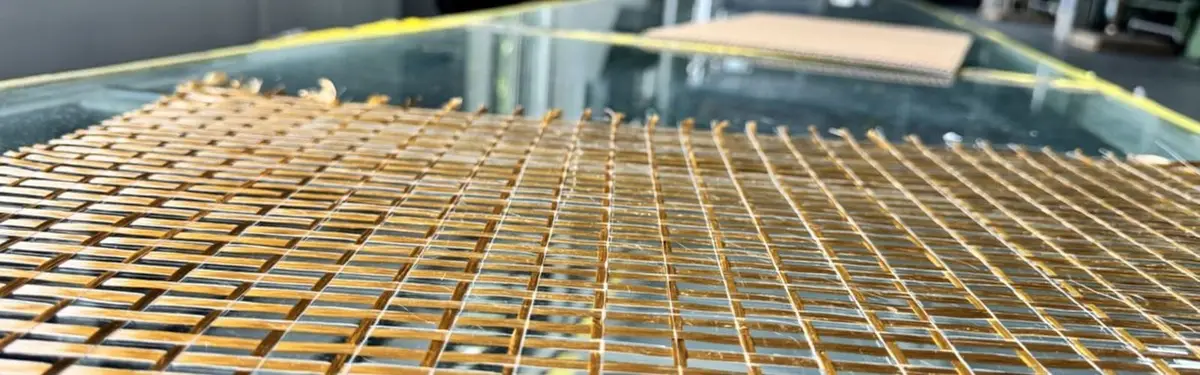
PBO Mesh for FRCM Strengthening Systems
Three PBO meshes — FPM 44, FPM 88 (unidirectional) and FPM 18/70 (bidirectional) — embedded in FMM mineral mortar for masonry and concrete strengthening. Supplied by FidStrong, Shanghai; system data reported to CNR-DT 215/2018 and the ACI 549.4R-20 / AC434 basis.

Specifications at a glance
FPM is a 100% PBO mesh for fabric-reinforced cementitious matrix (FRCM) strengthening — the mesh is embedded in FMM mineral mortar rather than in epoxy. That single difference is why FRCM is chosen: an inorganic matrix can be applied to a damp substrate, is vapour-permeable, and does not soften at a glass-transition temperature the way an epoxy does. PBO itself is the strongest fibre we supply, at 5800 MPa filament strength and a decomposition temperature of 650 °C.
| Property | Value |
|---|---|
| Models | FPM 44 · FPM 88 (unidirectional) · FPM 18/70 (bidirectional) |
| Fibre | 100% PBO (poly-p-phenylene benzobisoxazole) |
| Colour | Gold yellow |
| Fibre Tensile Strength | 5,800 MPa |
| Fibre Elastic Modulus | 270 GPa |
| Fibre Elongation at Break | 2.5% |
| Fibre Density | 1.56 g/cm³ |
| Decomposition Temperature | 650°C |
| Dry Mesh Elastic Modulus | FPM 44: 180 GPa · FPM 88: 190 GPa · FPM 18/70: 240 GPa |
| Available Width | 100 cm (unidirectional 25 cm) or customised |
| Packaging | 20 m / roll or customised length |
| Storage | Dry, away from direct sunlight, −5°C to +35°C |
| Shelf Life | Unlimited in original, unopened packaging |
| Matrix | Embedded in FMM cementitious matrix — the mesh is not used on its own |
Where It Is Used
Historic and heritage masonry
Vapour-permeable and removable, which is what conservation authorities usually require. An epoxy layer sealed onto old masonry is a durability problem, not a repair.
Damp and below-grade substrates
Basements, retaining walls and structures that never fully dry — the mineral matrix goes onto a saturated surface-dry substrate where an epoxy system cannot start.
No glass transition to soften
The matrix is a mortar and PBO decomposes at 650 °C (TDS). The FPM + FMM assembly has not been fire-rated as a system — the advantage is the absence of an epoxy Tg, not a tested rating; specify separate protection where a rating is required.
Seismic strengthening of masonry
Panel confinement and in-plane strengthening, where the bidirectional FPM 18/70 covers both directions in one layer.
Vaults, arches and curved surfaces
A mesh follows geometry a plate cannot, and the render finish suits surfaces that will be seen.
Industrial and water structures
Tanks, channels and silos where the surface has to stay permeable and the repair has to tolerate a wet substrate.
Reinforced concrete beams, slabs and columns
Flexural and shear strengthening of RC beams, slabs and walls, and column confinement — the first intended use on all three datasheets. Design basis: ACI 549.4R-20 (concrete).
Which FPM mesh for which job?
| Model | Mesh | Choose it when |
|---|---|---|
| FPM 44 | Unidirectional · 44 g/m² warp · 0.028 mm | The light mesh, for repairs where the strengthening demand is modest or where several thin layers suit the geometry better than one heavy one. Note that its datasheet carries fibre and mesh data only — there are no reported FRCM system values for it, so it cannot be used where the specification calls for a system tested to AC434 or CNR-DT 215. |
| FPM 88 | Unidirectional · 88 g/m² warp · 0.056 mm | Twice the fibre of FPM 44 in one layer, and the model whose system values are reported as CNR-DT 215/2018 characteristic values. The default for one-directional strengthening — beam soffits, wall strips. |
| FPM 18/70 | Bidirectional 0°/90° · 70 g/m² warp + 18 g/m² weft | Load in two directions from one layer — masonry panels, slabs spanning both ways, confinement work. System values reported on the ACI 549.4R-20 / AC434 test basis. The weft is deliberately light: it holds the warp on line and carries the secondary direction, it is not a second main reinforcement. |
| FRCM or epoxy CFRP? | FRCM (PBO mesh + mineral matrix) | Epoxy CFRP (fabric or plate) |
|---|---|---|
| Substrate moisture | Tolerant — a mineral matrix goes onto a saturated surface-dry substrate. | Restrictive — epoxy systems need a dry substrate; check the adhesive TDS for the moisture limit. |
| Temperature limit | No glass transition to soften. PBO fibre decomposes at 650 °C, and the matrix is a mortar. | Governed by the epoxy’s Tg — service temperature must stay well below it, which is the key limit on epoxy CFRP. |
| Vapour permeability | Permeable, which is why conservation work on historic masonry usually specifies FRCM. | A sealed epoxy layer traps moisture behind it — a real problem on old masonry. |
| Reversibility | A mortar layer can be removed. Heritage authorities often require this. | Bonded epoxy is not practically reversible. |
| Stiffness delivered | Lower — the cracked-phase system modulus is a fraction of the bare fibre’s. The matrix cracks by design, and load transfers across those cracks. | Higher and more direct: the epoxy holds the fibre continuously. |
| Surface finish | A render. It can be finished and painted like any mortar. | A thin resin film, usually needing a protective coating. |
The mesh is never used alone — it is embedded between two layers of FMM mineral matrix, which builds a system 6–10 mm thick depending on the model. Order the mortar with the mesh: coverage, layer count and the matrix are what make the tested system, not the mesh on its own.
Read the two tables below in order, and mind the last column of the second one. FPM 88 and FPM 18/70 are reported on different test bases — CNR-DT 215/2018 and ACI 549.4R-20 / AC434 respectively — and those standards define the reported strength differently. The numbers are therefore not comparable to each other, and neither is comparable to a competitor’s figure until you know which standard produced it. Design belongs to the project engineer under whichever of the two your specification names. ACI 549.4R-20 covers concrete members; masonry design follows ACI 549.6R-20, which asks for a longer anchorage length (300 mm against 152 mm in the concrete guide).
What do the mesh and system numbers actually mean?
The mesh itself — comparable across all three
| Model | Warp (g/m²) | Weft (g/m²) | Warp thickness (mm) | Weft thickness (mm) | Dry mesh modulus (GPa) |
|---|---|---|---|---|---|
| FPM 44 | 44 | — | 0.028 | — | 180 |
| FPM 88 | 88 | — | 0.056 | — | 190 |
| FPM 18/70 | 70 | 18 | 0.046 | 0.011 | 240 |
All three share the same PBO filament: 5800 MPa tensile, 270 GPa modulus, 2.5% elongation, 1.56 g/cm³, decomposition at 650 °C. What differs is how much of it there is and how it is woven. Dry mesh modulus is lower than filament modulus because the yarn is not perfectly straight in the weave. On the FPM 18/70 datasheet banner the 88 g/m² figure is the 70 + 18 g/m² total of both directions — not the same quantity as FPM 88’s 88 g/m² warp.
The FRCM system — not comparable between models
| Model | System thickness (mm) | Reported strength (MPa) | Strain (%) | Cracked modulus (GPa) | Reported to (test basis) |
|---|---|---|---|---|---|
| FPM 44 | — | — | — | — | — |
| FPM 88 | 6–10 | 2780 | 0.96 | — | CNR-DT 215/2018 |
| FPM 18/70 | 6–8 | 1535 | 1.65 | 130 | ACI 549.4R-20 / AC434 |
The 2780 and the 1535 are not the same quantity. FPM 88 is reported to CNR-DT 215/2018 as characteristic values (its conventional limit stress is 1880 MPa at 0.96% strain, with 2780 MPa the ultimate); FPM 18/70 is reported to AC434 as an ultimate tensile strength with a cracked-phase modulus. Comparing them directly, or comparing either to a competitor’s headline, tells you nothing until the standard is matched. FPM 44 has no reported system data at all — its datasheet stops at the mesh. Test report reference available on request.
The 5800 MPa on the fibre line is the filament, not the system: by the time the mesh is woven and embedded in mortar, the reported system strength is a fraction of it. That is normal for every FRCM product on the market — but it is the reason a supplier quoting only a fibre number is not telling you anything you can design with. Ask which standard the system was tested to, and get the report reference.
Applying an FRCM System in Six Steps
Prepare and wet the substrate
Remove render, loose material and laitance back to a sound surface, and roughen it. Unlike an epoxy system, the substrate should be saturated surface-dry before the matrix goes on — a dry masonry substrate pulls water out of the mortar and starves the cure.
Lay the first matrix coat
Apply FMM to the full area at the thickness the system calls for, working it into the surface rather than floating it on. This coat, not the mesh, is what bonds to the structure.
Bed the mesh while the matrix is fresh
Press the mesh into the wet matrix so the mortar comes through the openings. Mesh laid onto a set coat is not embedded, it is stuck on, and it will not develop the system properties. Mind the direction: the warp is the strong direction on the unidirectional models.
Overlap where the standard says
Laps, edge distances and anchorage are set by the design and the test standard, not by convenience. If the section needs anchors, FCA 10/450 carbon anchors are the matched component.
Close with the second matrix coat
Apply the second layer to bring the system to 6–10 mm depending on the model, fully covering the mesh. Any mesh visible through the surface is mesh that is not working.
Cure it like mortar, not like resin
Protect from rapid drying, direct sun and wind, and keep it damp through the early cure. This is a cement system: it needs water to gain strength, which is the opposite of the epoxy discipline installers are usually trained on.
Frequently Asked Questions
Why choose FRCM over epoxy CFRP?
Four reasons, and they are all about the matrix rather than the fibre: it can be applied to a damp substrate, it stays vapour-permeable, it has no glass transition temperature to soften at, and it can be removed later. If none of those matter for your job, epoxy CFRP will usually give more stiffness for the money.
Why is the system strength so much lower than 5800 MPa?
Because 5800 MPa is the bare PBO filament. Weaving it into a mesh, then embedding that mesh in a mortar that cracks by design, gives a system whose reported strength is a fraction of the filament figure — 1535 MPa for FPM 18/70 to AC434, for example. Every FRCM product on the market behaves this way. The number to design with is the system number, tested to a named standard.
Can I compare FPM 88 and FPM 18/70 by their strength numbers?
No, and this is the trap. FPM 88 is reported to CNR-DT 215/2018 and FPM 18/70 to ACI 549.4R-20 / AC434, and those standards define what is reported differently — conventional limit stress against ultimate tensile strength, on different strain bases. Choose by the standard your specification names and by the geometry of the job, not by which number looks bigger.
What about FPM 44 — why is its system row empty?
Because its datasheet stops at the mesh: fibre properties and mesh properties, no reported FRCM system values. That is honest reporting rather than an omission on this page, and it means FPM 44 is not the right choice where a specification calls for a system tested to AC434 or CNR-DT 215. For those jobs use FPM 88 or FPM 18/70.
Can the mesh be used with any mortar?
No. The test data belong to a system — a specific mesh in a specific matrix — so substituting the mortar voids the test data the design relies on. FPM meshes are tested with FMM, and that is what should be ordered and installed with them.
How thick is the finished system?
6–8 mm for FPM 18/70 and 6–10 mm for FPM 88, in two matrix layers with the mesh bedded between them. That is thicker than an epoxy laminate, which matters for headroom and for cover to existing detail.
Do you have a third-party approval for the system?
The FPM 88 and FPM 18/70 datasheets report system values on the CNR-DT 215/2018 and ACI 549.4R-20 / AC434 bases respectively. We do not hold a European Technical Assessment or an ICC-ES evaluation report. If your specification requires a specific third-party approval, tell us at enquiry stage and we will say plainly whether we can meet it.
Which FPM mesh matches a 70/18, 22/22 or 105 g/m² PBO mesh specification?
FPM 18/70 has the same 70 g/m² warp + 18 g/m² weft geometry as a 70/18 specification. For 22/22 balanced or 105 g/m² unidirectional specifications we do not offer a like-for-like model; FPM 88 is the nearest unidirectional weight. Send the specification and we will say which model fits and which does not.
Documents & Downloads
One TDS per mesh, plus the matrix
FPM 44, FPM 88 and FPM 18/70 each have their own datasheet, and FMM has its own. Take all of them — the system is the mesh and the mortar together.
MTC + COA with every shipment
Every batch ships with a Mill Test Certificate and a Certificate of Analysis.
Request a Quote
Tell us three things: the substrate, what the strengthening has to achieve, and which standard your specification names — AC434 or CNR-DT 215 changes which mesh is the right answer. An engineer comes back within one working day with the model, the mortar quantity and the datasheets. If FRCM is the wrong system for your case and epoxy CFRP is the right one, we will say so.


