
At a glance
- The matrix, not the fiber, decides heritage suitability. FRCM (fabric-reinforced cementitious matrix) uses a breathable mineral mortar instead of epoxy, so it is vapor-permeable and inherently fireproof — epoxy softens near its glass-transition temperature of only 60–82°C (ACI 440.7R-22).
- FRCM lifts masonry out-of-plane bending 3–4×, in-plane shear 2–3×, and arches or vaults up to 5× (ACI 549.6R-20 §6) — but design uses only a fraction of the raw fiber: flexural strain is capped at 1.2%, shear at 0.4%.
- PBO or carbon mesh in a lime-based mortar is the code’s own historic-building combination (ACI 549.6R-20 §3.5/§4.3), and anchorage on masonry needs 300 mm — double the 152 mm required on concrete.
Historic brick and stone masonry can be strengthened with carbon fiber — but the right system for a heritage building is almost always FRCM, a carbon or PBO mesh set in a breathable mineral mortar, not an epoxy-bonded CFRP laminate. The fiber is the same family; the matrix is what makes it compatible with a listed façade. This guide explains why, what FRCM can achieve on walls, arches, and vaults, and the design limits that keep the intervention honest — grounded in ACI 549.4R/549.6R-20 and AC434. If FRCM is new to you, start with FRCM mesh vs. CFRP fabric.
Why is historic masonry so vulnerable — and why is the matrix the real decision?
Unreinforced masonry has very low tensile capacity and behaves brittlely: under seismic, wind, or soil pressure it fails by flexural cracking, diagonal shear cracking, and out-of-plane overturning. Strengthening restores tensile continuity the masonry never had. The engineering choice that matters for a heritage building, though, is not the fiber but the matrix that binds it to the wall. Epoxy CFRP seals the surface and requires a substrate below 4% moisture; a mineral FRCM matrix is vapor-permeable, tolerates a damp (saturated-surface-dry) substrate, and is compatible with lime and historic mortars — the properties conservation work demands. It is also inherently fireproof, where epoxy loses stiffness and bond near its glass-transition temperature (see below).
What is FRCM, and why does it suit heritage masonry better than epoxy CFRP?
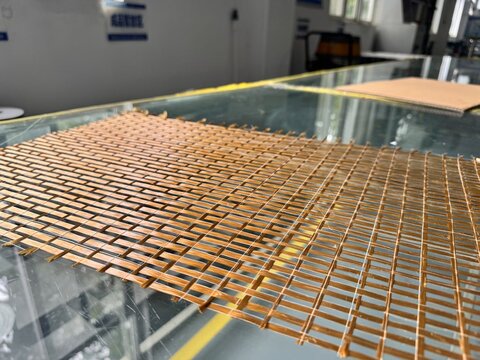
FRCM is an open carbon or PBO mesh embedded in an inorganic (cement- or lime-based) mortar rather than epoxy. Four differences make it the heritage default:
- Breathable vs. sealed: the mineral matrix is vapor-permeable, so trapped moisture does not blister historic renders; epoxy forms a vapor barrier.
- Fireproof vs. Tg-limited: the inorganic matrix has no glass-transition limit, while epoxy Tg is only 60–82°C and bond degrades sharply near it (ACI 440.7R-22 §3.3.3).
- Damp-tolerant vs. dry-only: FRCM is applied to a saturated-surface-dry substrate; epoxy needs the substrate below 4% moisture.
- Mortar-covered vs. UV-sensitive: FRCM’s mesh is buried in mortar and needs no UV topcoat; cured epoxy FRP must never be left exposed to UV.
How much can FRCM actually strengthen masonry?
The gains are substantial and are documented by strengthening mode in ACI 549.6R-20 §6:
| Element / mode | Typical capacity gain | Note |
|---|---|---|
| Wall, out-of-plane flexure | 3–4× | Most common heritage application |
| Wall, in-plane shear | 2–3× | Check mass/stiffness jointly beyond 3× |
| Column / pier confinement | +10–20% | Axial increment capped at ≤20% |
| Arch / vault | up to 5× | Restrains the collapse mechanism |
These are meaningful upgrades for seismic compliance without adding the mass a concrete jacket would. But the headline multiples come with a hard ceiling on how much of the fiber the design may actually mobilise — the next section.
How much of the fiber can a design actually use?
Far less than the dry-fiber strength suggests, because FRCM design strain is capped low to keep the mesh anchored in the mortar. Per AC434 and ACI 549.4R/549.6R-20, flexural (out-of-plane) design strain is εfd = 0.7εfu ≤ 0.012 (1.2%) and shear design strain is εfv = 0.4εfu ≤ 0.004 (0.4%), with effective stress ffe = 0.85·Ef·εfe. That cap applies regardless of what the raw fiber can do: dry PBO elongates about 2.5% and dry carbon about 1.8%, so a design uses only a fraction of either. PBO’s higher elongation is why it is favored where seismic deformation capacity matters — its mesh (about 5,800 MPa tensile, decomposition near 650°C) tolerates more strain before the mortar-to-mesh bond gives out.
How do you strengthen a wall out-of-plane against seismic loads?
Out-of-plane overturning is the classic unreinforced-masonry failure. FRCM strips run vertically on the wall face to carry the bending induced by the wall’s own inertia. Two failure modes are checked: Mode I, masonry crushing at the compression face (strain reaches εmu), and Mode II, FRCM debonding or rupture at the tension face (strain reaches εfd). The URM out-of-plane force-transfer limit is 380 N/mm (2,200 lbf/in.) (ACI 549.6R-20 §7). Slender walls also benefit from an arching effect that develops when the height-to-thickness ratio H/t < 8, diminishes above 14, and is ignored above 20. Crucially, the strips must be developed into the diaphragm and footing: minimum anchorage on masonry is 300 mm where no test data exists — double the 152 mm allowed on concrete — and multi-wythe or rubble walls need transverse connectors at 0.5–2 per m² to stop the leaves separating.
Can FRCM strengthen arches and vaults without epoxy?
Yes — this is one of FRCM’s strongest heritage uses. An unreinforced arch collapses as a four-hinge mechanism; FRCM restrains the crack openings that form the hinges, raising capacity up to 5×. It can be applied on the extrados (the compression/outer side, giving better bond) or the intrados (the inner side, easier to access but in tension, so it needs mechanical connectors). Single-curvature arches are analysed by the kinematic method; double-curvature vaults by the static method. The same effective-strain cap applies, εlim = 0.012. Because the intervention is a thin mortar layer, it preserves the geometry and appearance of the original structure far better than a concrete overlay.
When is epoxy CFRP still the right choice?
FRCM is the heritage default, not a universal replacement. Where the substrate is dry, ventilated, and not a decorative breathing surface — and the job calls for a thin, high-modulus, point-specific strengthening — epoxy CFRP is still the better engineering answer. It develops higher usable stress in a thinner section and anchors in a shorter length (152 mm on concrete vs. 300 mm for FRCM on masonry). Even suppliers of FRCM-type products position them as “an alternative where an FRP system is not suitable,” not as a wholesale substitute. The honest rule: let moisture, breathability, fire, and substrate compatibility drive you to FRCM; let thinness, high modulus, and a sound dry substrate keep you on epoxy CFRP.
What does a sound FRCM installation require?
The mortar and bond are as important as the mesh. The FRCM mortar must reach at least 24 MPa (3,500 psi) 28-day compressive strength (AC434 §4.3); FidStrong’s FMM mortar reports 53 MPa compressive and 2.0 MPa concrete bond, well above the floor. Substrate pull-off must be ≥1.0 MPa and the acceptance test requires cohesive failure at ≥200 psi (1.38 MPa). Installation runs: dampen the substrate to saturated-surface-dry → first mortar coat 3–5 mm → embed the mesh wet with lap splices ≥300 mm and corners rounded to r ≥20 mm → second coat after initial set (about 2–4 h at 20°C) → total system 6–10 mm with no exposed mesh. Durability is well documented: FRCM retains ≥85% of capacity after 1,000 h and ≥80% after 3,000 h of water, saltwater, and alkali exposure (AC434 Table 2). Choose the mesh to suit the job — PBO mesh for deformation capacity, carbon mesh for stiffness and economy, both in FRCM mineral mortar. For the seismic design context, see seismic retrofit with carbon fiber.
FAQ
Why choose FRCM over epoxy CFRP on a listed or historic masonry building?
Because FRCM’s inorganic mortar matrix is vapor-permeable and compatible with lime and historic mortars, whereas epoxy seals the surface and softens near its 60–82°C glass-transition temperature (ACI 440.7R-22 §3.3.3). FRCM is also inherently fireproof and can be installed on a damp (saturated-surface-dry) substrate, matching the moisture and breathability demands of conservation work.
How much of the fiber’s tensile strength can an FRCM design rely on?
Only a fraction. Flexural design strain is capped at εfd = 0.7εfu ≤ 1.2%, and shear at εfv = 0.4εfu ≤ 0.4% (AC434 / ACI 549.6R-20), regardless of whether the dry fiber elongates 1.8% (carbon) or 2.5% (PBO). The mesh-to-mortar bond, not the raw fiber strength, governs.
How much can FRCM increase a masonry wall’s capacity?
Per ACI 549.6R-20 §6: out-of-plane flexure 3–4×, in-plane shear 2–3×, arches and vaults up to 5×, and column/pier confinement +10–20% (capped at a 20% axial increment). Gains beyond 3× in shear require checking mass and stiffness jointly.
Can FRCM strengthen a masonry arch or vault without epoxy?
Yes. An unreinforced arch fails as a four-hinge mechanism; FRCM restrains the hinge cracks for up to a 5× capacity gain (ACI 549.6R-20 §10). Apply it on the extrados for better bond, or the intrados with mechanical connectors since that face is in tension; single-curvature arches use the kinematic method, double-curvature vaults the static method.
What anchorage length does FRCM need at a wall edge?
A minimum of 300 mm (12 in.) where no manufacturer test data is available — double the 152 mm required on concrete — with corners rounded to r ≥20 mm before wrapping (ACI 549.6R-20 §11). Multi-wythe or rubble walls also need transverse connectors at 0.5–2 per m² to prevent leaf separation.
Is epoxy CFRP ever still appropriate on a heritage building?
Yes — where the substrate is dry and ventilated, the surface is not decorative or breathing-critical, and the job needs thin, high-modulus, point-specific strengthening. Epoxy develops higher usable stress in a thinner section and anchors in a shorter length. Let moisture, breathability, and fire drive the choice to FRCM; a sound dry substrate can keep it on epoxy CFRP.
FidStrong manufactures FCM carbon mesh, FPM PBO mesh, and FMM mineral mortar for FRCM strengthening, plus epoxy CFRP systems where a dry substrate calls for them, under ISO 9001, 14001, and 45001 systems. Design values here follow ACI 549.4R/549.6R-20 and AC434; conservation principles such as minimal intervention are general practice, not code clauses. Confirm every value against the governing code and a qualified conservation engineer’s design.