
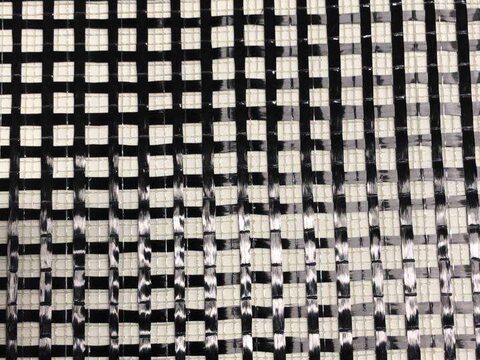
At a glance
- A CFRP wrap restores structural capacity, it does not stop corrosion. Confinement raises the strength and ductility of a corrosion-damaged column or pile — but ACI 440.2R has no cathodic-protection or corrosion-arrest content, so treat the electrochemical cause separately.
- Carbon’s environmental factor is CE = 0.85 for both exterior and aggressive exposure (ACI 440.2R Table 9.4) — so how you classify a splash-zone pier does not change the carbon design number, though it changes glass sharply (0.65 vs 0.50).
- Carbon fiber is conductive and must never directly touch steel — a glass-fiber interlayer is used as a dielectric barrier where steel hardware is unavoidable. Carbon also retains ~90% of strength after 50 years vs. ~30% for glass.
Wrapping a corrosion-damaged marine column or pile in CFRP is a proven way to restore its structural capacity and ductility — but it is a structural repair, not a corrosion cure, and it demands honesty about what the wrap does and does not do. This guide covers the confinement mechanics, the marine-specific design factors, the galvanic trap, and the moisture limits that decide whether you can even bond in a tidal zone — grounded in ACI 440.2R and FidStrong product data. For the underlying aging behaviour, see durability of CFRP strengthening.
What actually destroys marine concrete?
Chloride ingress is the primary driver. Seawater chlorides penetrate the concrete cover and, together with carbonation and freeze–thaw cycling, depassivate and corrode the embedded reinforcement. The corroding steel expands, cracking and spalling the cover (“rust-jacking”) and losing section — the standard deterioration mechanism for marine and coastal structures. Attack is worst in the tidal and splash zone, where alternating wetting, drying, and oxygen give corrosion everything it needs. The result is columns, piles, pier caps, and seawalls that have lost capacity and need it restored.
What does a CFRP wrap actually do — and what does it not do?
Be clear on both halves. What it does: a circumferential CFRP wrap confines the concrete, putting the core into triaxial compression that raises confined strength and, importantly, ductility — the documented use case is exactly “confinement repair of corrosion-cracked, spalled columns” (ACI 440.2R Ch. 12). What it does not do: stop the corrosion. Nothing in ACI 440.2R supports the claim that a CFRP wrap arrests or reverses chloride-driven rebar corrosion — there is no cathodic-protection, corrosion-inhibitor, or chloride-threshold content in the design guide. The wrap addresses the structural consequence, not the electrochemical cause.
How does the confinement actually work?
Passively. As the confined concrete is loaded and tries to dilate laterally, it strains the wrap in hoop tension, which pushes back with a confining pressure fℓ = 2·Ef·n·tf·εfe / D. That lateral pressure raises the confined compressive strength to f′cc = f′c + ψf·3.3·κa·fℓ and, just as valuably, lets the section reach far higher ultimate strain before failure — turning a brittle, spalled column into a ductile one. The wrap is only mobilised as the concrete dilates, which is why it is called passive confinement. For sizing the layers, see how to calculate CFRP layers for column confinement.
What design strength can you use in a marine environment?
Start from the environmental reduction factor CE, which multiplies the fiber’s characteristic strength and strain (ACI 440.2R Table 9.4). For carbon it is the same — 0.85 — whether the exposure is classed “exterior” (bridges, piers) or “aggressive” (chemical, wastewater), so a splash-zone pier lands on 0.85 either way. That is a genuine advantage of carbon: glass drops from 0.65 to 0.50 across the same classification gap. Florida DOT — a coastal jurisdiction with 20+ years of externally bonded CFRP on corrosion- and impact-damaged bridges — independently mandates CE = 0.85 for bridge work.
| Fiber | Interior | Exterior (piers) | Aggressive |
|---|---|---|---|
| Carbon | 0.95 | 0.85 | 0.85 |
| Glass | 0.75 | 0.65 | 0.50 |
| Aramid | 0.85 | 0.75 | 0.70 |
The long-term case reinforces the choice: carbon retains about 0.90 of its strength under 50-year sustained load, against roughly 0.30 for glass (ACI 440.2R Sec. 4.4.1) — decisive for a structure meant to serve decades in seawater.
Why doesn’t CFRP corrode — and where’s the trap?
Bare carbon fiber resists both alkaline and acidic environments, which is exactly why ACI 440.2R recommends carbon over glass for high-alkalinity, high-moisture service — bare glass fiber degrades in alkali, with only the resin protecting it. But carbon buys that durability with a hazard: it is electrically conductive, so direct contact between a CFRP wrap and steel (exposed rebar, steel anchor plates, dowels) creates a galvanic cell that accelerates the steel’s corrosion. ACI 440.2R Sec. 9.3 and Eurocode Annex JA both prohibit direct CFRP–steel contact. Where steel hardware is unavoidable, the standard mitigation is a glass-fiber interlayer acting as a dielectric barrier — glass and aramid fibers are non-conductive and carry no galvanic risk.
Can you even bond CFRP on a damp tidal substrate?
Only within limits, and timing is everything. The full epoxy system needs substrate moisture below 4% (ASTM D4263); the primer alone may go onto a damp (not wet) surface, but the system must never be applied over standing or free water. Get this wrong and water vapour migrating out of the substrate through the uncured resin blisters the laminate and destroys the bond — a failure mode ACI 440.2R-23 §6.2 names explicitly, with the remedy being a moisture check (ACI 503.4) and a moisture-tolerant primer (§6.4.2.1). In practice that means working the low-tide window so the splash-zone surface can dry to the threshold, and never chasing a receding tide with resin. A wet or humid service life also lowers the epoxy’s effective glass-transition temperature, so keep service temperature well under Tg − 15°C. See surface preparation for optimal bond.
What about non-corroding reinforcement for new marine work?
Two related but distinct options, which should not be confused with external wrapping. For new or replacement internal reinforcement — dock walls, jetties, seawalls, splash-zone slabs — GFRP rebar is chosen precisely because it is immune to chloride, carbonation, and alkaline attack; that is internal bar for new pours, not a wrap on an existing column. And where a wet substrate or fire makes epoxy cure conditions marginal, an FRCM (cement-matrix) system — a carbon mesh in mineral mortar — applies to a saturated-surface-dry substrate and has documented immersion durability (≥85% strength retained after 1,000 h, ≥80% after 3,000 h in water, saltwater, and alkali). It is a different product family from the epoxy CFRP wrap this article centres on, but a legitimate alternative when cure moisture is the problem.
FAQ
If I wrap a corroded marine pile in CFRP, does that stop the corrosion?
No. CFRP confinement restores the structural capacity and ductility of the section (ACI 440.2R Ch. 12); it is not a corrosion-arrest technique. Nothing in the design guide supports a claim that a wrap halts chloride-driven rebar corrosion — if active corrosion is the concern, it needs a separate assessment and treatment such as cathodic protection.
What environmental reduction factor should I use for a CFRP wrap on a marine pier?
CE = 0.85 for carbon. ACI 440.2R Table 9.4 gives 0.85 for both “exterior” (bridges, piers) and “aggressive” (chemical, wastewater) exposure, so a splash-zone pier is 0.85 regardless of which category you assign. If glass fiber were used instead, the classification would matter a lot — 0.65 exterior versus 0.50 aggressive.
Can the CFRP wrap touch the exposed corroded rebar or a steel anchor plate?
No — avoid direct contact. Carbon fiber is electrically conductive, and CFRP-to-steel contact forms a galvanic couple that accelerates the steel’s corrosion; ACI 440.2R §9.3 and Eurocode Annex JA both prohibit it. Where steel hardware is unavoidable, use a non-conductive glass-fiber layer as a dielectric barrier between the carbon and the steel.
Can CFRP be installed on the damp concrete of a tidal or splash zone?
Only within limits. The full epoxy system needs substrate moisture below 4% (ASTM D4263); the primer alone can go on a damp (not wet) surface, but never over standing water. Cure-stage moisture causes blistering that destroys the bond (ACI 440.2R-23 §6.2), so work the low-tide window and use a moisture-tolerant primer if there is any doubt.
Why choose carbon over glass fiber for a marine structure?
Durability under sustained load and alkalinity. Carbon retains about 0.90 of its strength after 50 years versus roughly 0.30 for glass (ACI 440.2R Sec. 4.4.1), and ACI recommends carbon over glass in high-alkalinity, high-moisture service. The trade-off is carbon’s conductivity, which requires keeping it off bare steel.
Is GFRP rebar the same as a CFRP wrap for marine repair?
No — they are different jobs. GFRP rebar is non-corroding internal reinforcement for new or replacement pours (dock walls, seawalls, splash-zone slabs). A CFRP wrap is external confinement applied to an existing, already-corroded column or pile. Don’t substitute one for the other.
FidStrong manufactures FSC carbon fabric with moisture-tolerant primers and matched saturating epoxies, plus glass-fiber and FRCM systems for marine service, under ISO 9001, 14001, and 45001 systems. Design values here follow ACI 440.2R; CFRP wrap restores structural capacity, not corrosion protection. Confirm every value against the governing code and a qualified marine engineer’s design, and treat active corrosion as a separate assessment.